Showing posts sorted by relevance for query 99. Sort by date Show all posts

Friday, March 20, 2026

🎶 I can see clearly now the rain is (almost) gone 🎶

SR 99 from Lynnwood to Everett

You turned your clock back. The birds are singing. It's lighter later. And – dare to dream – the rainy season may soon be over. Spring is just around the corner, and so too is a new vision for SR 99 from Lynnwood to Everett. We are excited to share the final SR 99 Lynnwood and Unincorporated Snohomish County Pre-design Study report available on the study webpage.

Read on to learn about how and why we're trying to improve SR 99 for all travelers, what we've learned by talking to the community, and what's up next for our work.

Map of the SR 99 study area from 212th Street Southwest in Lynnwood to Airport Road in unincorporated Snohomish County, showing jurisdiction boundaries and key routes.
Map showing the SR 99 study corridor from Lynnwood to unincorporated Snohomish County

🎶I can see all obstacles in my way 🎶

We know that this section of SR 99 has its challenges. Originally designed for cars and commerce, SR 99 through Snohomish County has room for improvement when it comes to providing comfortable, reliable options for all modes of transportation.

In 2023, we received grants to study how to improve SR 99 to meet Complete Streets requirements and to better integrate SR 99 into the local network. One way we assessed what improvements are needed is by looking at the key challenges of the area based on data and community and agency feedback. Challenges identified include:

  • Stressful conditions for people walking and biking.
  • Incomplete bike and pedestrian facilities and missing connections.
  • Large distances between controlled pedestrian crossings.
  • Between 2019 and 2023, there were more than 60 fatal or serious injury crashes.
  • Unreliable or lack of access to transit.
  • Balancing the needs of freight and local traffic.
  • Too few affordable, healthy travel options for everyone.

However, for all its challenges, this section of SR 99 has so many opportunities:

  • Three Community Transit Swift bus rapid transit lines run along (Blue line) or cross (Orange and Green lines) the corridor.
  • Link light rail is close by today, while a future unfunded Link station at SR 99 and Airport Road will serve the community.
  • Existing and future planned Business Access and Transit lanes between 148th Street Southwest and Airport Road to help prioritize buses over other vehicles.
  • Paine Field is just north of the area, serving as a major regional travel and employment hub.
  • New housing options are being developed right along the corridor.
Photograph of a multi-story apartment building along SR 99 with vehicles on the roadway in the foreground.
New housing is being built along the SR 99 corridor in Snohomish County

🎶 Here is the rainbow I've been prayin' for 🎶

We wanted to hear what you, the community, thought about options to improve SR 99. And hear from you we did! We heard comments and feedback from nearly 1,000 people via tabling events, online open houses and surveys, and focus groups.

According to you, these are the most important investments we could make:

Theme Summary of Community Feedback
Better Transit Service Community emphasized the need for buses to be on schedule and reliable. Community requested easier access to bus stops.
Pedestrian‑Level Amenities and Lighting Community highlighted the importance of better lighting and a more welcoming streetscape for pedestrians, specifically landscaping and trees.
Slow Traffic Speeds Community requested slower traffic speeds in locations where speeding and walking frequently overlap.
More Frequent Controlled Crossings Community identified areas lacking controlled crossing spots, particularly around commercial areas and activity centers.

Based on this feedback, we developed two types of recommendations.

The first type of recommendation was for corridor-wide concepts which show the details of a roadway like number of lanes, bicycle and pedestrian facilities and center median. There were two of these: separated bike lanes or shared-use paths.

Take a look at each of these:

Cross-section illustration of SR 99 showing vehicle lanes plus a buffer-separated bike lane alongside a sidewalk, with landscaped elements between modes.
Corridor-wide concept showing separated bike lanes and sidewalks alongside SR 99
Cross-section illustration of SR 99 showing vehicle lanes plus a wide shared-use path for people walking and biking, separated from traffic by a landscaped buffer.
Corridor-wide concept showing a shared-use path that combines walking and biking space behind a landscaped buffer

While similar in that each recommended corridor-wide concept offers separate travel lanes for cars and buses, landscaping closest to the sidewalk, and improved pedestrian lighting, the big difference is how people walking or bicycling travel: either in separated bike lanes and sidewalks, or traveling together in a shared-use path. The idea for these two concepts is that they are interchangeable, depending on which concept makes the most sense in specific places.

The second type of recommendation are spot treatment packages which consist of multiple spot treatments in different types of locations. There are four spot treatment packages.

Four example spot-treatment images labeled: crossings for pedestrians, protected crossing islands, raised truck aprons, and raised crosswalks.
Examples of spot treatments that can make crossings shorter, clearer, and more comfortable for people walking and rolling

The first spot treatment package, Enhancements at Traffic Lights, combines multiple spot treatments like crosswalks, pedestrian crossings and crossing islands that could be implemented where there is an existing traffic signal such as the intersection of SR 99 and SR 524/196th Street Southwest.

Illustration of a signalized SR 99 intersection with safety upgrades such as high-visibility crossings, tighter turning geometry, and dedicated space for people walking and biking.
Package 1 combines multiple improvements that can be implemented at traffic signals to improve safety and comfort.

The third spot treatment package, controlled pedestrian crossing, adds a new signalized crossing for pedestrians in between roadway intersections, which combines crosswalks, a pedestrian island, pedestrian signals, and improved lighting spot treatments.

Spot Treatment Package 3: New Midblock Controlled Crossing Alt text: Street concept rendering showing a bus traveling in a dedicated lane with improved walking and biking space and landscaped buffers along the corridor.
Dedicated bus lanes can improve transit reliability while the corridor is redesigned to better support all travel modes.

Check out our complete study to learn more about the corridor-wide concepts and the spot treatment packages plus where we might build them.

🎶Look all around, there's nothin' but blue skies 🎶

We're excited about the corridor-wide concepts and spot treatment packages you helped us develop. These will provide new and improved options for people to walk, roll, bike, take the bus or drive:

  • Walk, roll, or bike: More dedicated space. Better connections to Swift buses along the corridor. Bike facilities. Improved sidewalks and crossings.
  • Take the bus: Dedicated bus lanes mean more reliable arrival times and better connections to light rail.
  • Drive: Maintaining four vehicle lanes (two in each direction). Access to residences, local businesses and services is maintained. Expect some traffic congestion during rush hour.

🎶 It's gonna be a bright (bright), bright (bright), sun-shiny day 🎶

Even though we finished our study, in a way, our work is just beginning.

We're going to keep working with the community and our partners at the cities of Lynnwood, Everett, and Edmonds, Snohomish County, Community Transit and Sound Transit. Together, we can figure out how to make these concepts reality.

Our study is only the first step. We will need additional funding, partnership and engagement to finish our work and build the complete vision.

Read more information on our project website: SR 99 Lynnwood and Unincorporated Snohomish County Pre-design Study | WSDOT

Take a 3-minute break with Jimmy Cliff, who inspired the theme of this blog post: https://youtu.be/MrHxhQPOO2c?si=Z68HwsNEQqBWnyii

Monday, April 13, 2026

Your Feedback in Action: How Community Input Guides a Project

By: Zack Howard

When we asked for feedback on improvements to State Route 99 between South 272nd and SR 516, the community responded in a big way. Your input helped shape the long-term vision for this project. We are grateful for your ideas and excited to share how they are influencing our work.

a map showing an orange line along State Route 99 where ADA improvements will be made from South 272nd Street to SR 512.
Project Vicinity Map 

Establishing the long-term vision while pushing for near-term change

Our goal is to build “Complete Streets.” These are roads designed for everyone, including pedestrians, bicyclists, and transit users. While the lack of available funding means we can’t build the SR 99 long-term vision preferred by the community, we do have funding for some bicycle and pedestrian improvements. These improvements will help make the road feel less stressful and more welcoming while we wait for the opportunity and funding to put the bigger vision in place.

Below, we’ll discuss both the deferred long-term vision and the near-term improvements we plan to implement, as well as the role the community played in helping us make these decisions.

Reaching the Community

Our online open house and survey ran from September 30 through November 8, 2025. Here is how we connected.

  • 763 people visited the project website.
  • 179 people completed the survey.
  • 19,000 postcards were mailed to residents and businesses.
  • Multiple Languages: The survey was available in English, Punjabi, Somali, Spanish, and Ukrainian.

What we heard and how it informs the corridor vision

How People Travel Today

Most people who took our survey said they don’t regularly walk, bike, or roll along this part of SR 99. About half said they rarely or never do. However, many people said they would walk or bike more often if the roads were improved.

This matches common travel patterns. People are more likely to use active transportation like biking if there are sidewalks and bike lanes. People feel more comfortable when those features are easy to access.

Why This Corridor Matters

People use this stretch of SR 99 in their everyday lives. Many respondents live nearby and travel along the corridor to shop, visit restaurants, attend appointments, commute to work or school, recreate and visit friends and family. The corridor functions as both a destination and a key regional route.

Safety Is the Top Priority

When we asked about long-term goals, one theme stood out: people want to move through this area with greater confidence.

The most common priorities included:

  • Better lighting and visibility
  • Support for drivers
  • Improvements for people walking, biking, and rolling
  • Safety and visibility in crosswalks

What Improvements People Want to See

When it comes to specific features, high-visibility crossings were the clear favorite. Other commonly supported improvements included:

  • Separated paths and bike lanes
  • Pedestrian refuge islands
  • Wider sidewalks

Some community members also suggested additional lighting, speed-control measures, and other safety-focused upgrades.

Where Improvements Are Needed Most

Respondents highlighted several key locations for improvement, including:

  • The intersection at South 272nd Street and SR 99
  • Kent Des Moines Road/SR 516 and SR 99
  • Areas between South 240th Street and South 252nd Street

Some people said the entire corridor could benefit from improvements, while others pointed to specific intersections, bus stops or businesses.

Everyday Destinations Along the Corridor

Many of the places people visit most often are everyday spots like grocery stores, shops, restaurants, the library, and Highline College. This shows how important it is to have reliable ways to get around on foot or by bike for daily needs.

How community feedback informed the recommended corridor vision

Your feedback on what you need and what you prefer directly guided our team’s decisions. Based on what we heard, we chose Alternative 2 as the preferred long-term vision for this area.

Right now, we have enough funding to pave the road and make some immediate improvements, but we do not yet have enough for the full Alternative 2 design. We will need to wait for additional funding before we can implement this design. When that time comes, we will return to the community. We want to make sure the plan still meets the needs of everyone who relies on SR 99. We are committed to keeping you informed every step of the way.

two southbound lanes separated from two northbound lanes by a median with trees and grass. Both the southbound and northbound lanes have a shared use path along side of them, separated by a buffer of trees and grass.
The selected preferred alternative, Alternative 2. 

In the meantime, WSDOT has worked with the City of Kent to identify near-term improvements – additions that include:

vehicles driving on a roadway, near a truck apron which is shown as red brick between the road and sidewalk.
Truck aprons – mountable curbs that let trucks execute wider turns but give pedestrians visibility as they approach the crosswalk

A roadway without cars, showing part of a crosswalk and an enhanced driveway.
Enhanced driveways – breaking up wider driveways to decrease crossing time for pedestrians and reduce conflicts with turning vehicles

A roadway with a roundabout and several cars. This image is highlighting an example of a speed cushion, which is shown as a raised, square shaped pad of asphalt with two white triangular shapes on it, which is used to slow vehicle speeds.
Speed cushions – slowing turning traffic to increase awareness of crossing movements. 

If you’d like to learn more about the online open house, the feedback we received, and how these decisions were made, read the full summary on our project webpage: Online Open House Summary

Next steps

Construction is currently scheduled to begin in summer 2026 to pave SR 99, upgrade ADA ramps, and construct improvements that can be implemented during the paving and ADA construction. These improvements include lane narrowing, speed cushions, truck aprons and enhanced driveways. Right now, funding is available for the near-term work. Additional funding will be needed before the full preferred long-term vision can be built.

As we move into construction, we’ll continue engaging with the community and coordinating closely with our agency partners. Your input remains an important part of how this project moves forward.

Learn more and stay informed

We are committed to transparency throughout this process, and your feedback and voice make a difference. Thanks for helping to make this community-driven.

Project webpage

Visit the project page for the latest updates, detailed information and recordings/presentations from our Advisory Group meetings.

Email updates: Sign up for news and study updates.

Contact Info

Amber Stanley - Community Engagement Lead

Phone: 206-817-8833

Email: amber.stanley@wsdot.wa.gov

Friday, January 16, 2026

Managing the Flow: A Revive I-5 Update

By: RB McKeon

Update: 3 p.m. Tuesday, Jan. 20, 2026

Revive I-5: Week one in review (follow-up update)

On Friday, Jan. 16, we shared some early observations just a few days into Revive I-5 construction on the Ship Canal Bridge. We’ve now had the opportunity to review a full week of traffic data and operational information. Here’s what we’re seeing after the first full week of lane reductions.

Early in the week, Monday, Jan 12, saw the heaviest delays as people encountered the new lane reduction pattern for the first time. As the week progressed, traffic conditions began to stabilize as drivers adjusted routes, schedules and travel choices. This is similar to what we observed during the 2025 Revive I-5 work.

Traffic patterns Jan 12-16 and the weekend of Jan. 17-18:

  • Regional shifts: Drivers redistributed to alternate routes like SR 99, I-405, SR 520 and I-90 as the system absorbed reduced northbound capacity on I-5.
  • Improving throughput: Despite two lane reduction on northbound I-5, the total number of vehicles moving across the Ship Canal Bridge increased from Monday to Friday in both directions.
  • Travel times trending better: Southbound travel times that were notably above normal early in the week improved by Friday. Northbound travel remains most congested in afternoon peaks.
  • Weekend looked more typical: Weekend travel volumes and travel times were nearer to typical weekend conditions than weekday commute peaks.

These patterns follow the expected adjustment curve we first saw in the summer 2025 Revive I-5 work, where travel behavior evolved as people settled into the new configuration of lanes and closures.

Express Lanes: Continued role after week one

As noted previously, the I-5 express lanes are operating northbound, 24 hours a day during this phase. This isn’t a like-for-like replacement of the capacity lost on the mainline. It’s an operational tool to help keep the system balanced when room for error is limited.

With the northbound mainline reduced from four lanes to two, even a single collision or disabled vehicle can quickly cause severe congestion. Keeping the express lanes available northbound gives traffic operators flexibility to respond to incidents and helps prevent a full shutdown of the corridor.

We understand it can be frustrating to see express lanes that don’t appear to be full, especially for southbound travelers. That visual contrast is real. During construction, however, the value of the express lanes is measured by how they absorb surges, incidents and breakdowns over the course of the day, not how they look at a single moment.

As weekday travel returned after the weekend, use of the express lanes increased and they helped maintain northbound throughput which is evidence of people incorporating the lanes into their travel patterns despite the unfamiliar configuration.

This express lane operation is temporary and tied to construction phases. When work shifts to the southbound lanes in 2027, express lane operations are expected to shift southbound for the same reason: to help restore capacity where it has been reduced.

Partner coordination during week one

Week one also included a Seahawks playoff game at Lumen on Saturday, Jan. 17, adding additional travel demand in and out of downtown Seattle. WSDOT worked closely with the City of Seattle, King County Metro, Sound Transit, and regional traffic operations teams to support game-day travel and provide reliable travel options, especially transit, which helped move large numbers of people while taking pressure off the highway system.

Looking ahead

Revive I-5 is long-term preservation work on a critical structure that carries hundreds of thousands of trips every day. While the early days of construction are often the most disruptive, the region saw measurable improvements over the first week as travel patterns shifted and drivers adjusted.

After completing the refreshed striping at the 45th/50th Street shoofly, our crews are ready to begin milling the bridge this week. This process allows us to remove the top layer of the bridge deck to prepare the surface for repairs. Using a large milling machine with a rotating drum covered in cutting teeth, the machine grinds off a precise depth of material, in this case, one inch to expose the underlying condition. This also helps create a clean and even surface and expose areas that need additional repairs.

We will continue monitoring traffic conditions closely and making operational adjustments where possible as work progresses. Travelers can help by planning ahead, checking real-time conditions before heading out, and considering transit, carpools, or trying one of the many available alternate routes.


Original blog:

Seahawks game on Saturday and weekend construction

It’s game week in Seattle, and with a Seahawks home game this Saturday, Jan. 17, a lot of people are focused on one thing: How do I get to kickoff without missing the action, and how do I get back home? With Revive I-5 construction already affecting travel around the Ship Canal Bridge, game-day traffic adds another layer to an already busy weekend.

If you’re heading downtown to cheer on the Hawks, transit is strongly encouraged and continues to be the easiest and most reliable way to get to and from the stadium during construction. Transit avoids the most constrained parts of the highway system and helps keep traffic moving for everyone.

In addition to the lane reductions on northbound I-5, this weekend, there is also work planned on northbound I-405 in Bellevue this weekend, which means we have construction on one of the routes people may opt to use instead of I-5.

Up to two lanes of northbound I-405 will be closed from Southeast Eighth Street to Northeast Fourth/Eighth Street from 11 p.m. Friday, Jan. 16, to 4:30 a.m. Monday, Jan. 19, with additional nightly lane closures north of I-90.

The following on-/off-ramps will be closed:

  • Southeast Eighth Street on-ramp to northbound I-405
  • Northbound I-405 off-ramp to Northeast Fourth/Eighth Street (Exit 13 A/B)

Signed detour routes will be in place for the ramp closures.

Game-day tip: plan ahead, check conditions before you go, and consider transit to get to kickoff and home again with less stress.

We’re Reviving I-5

If you’ve been traveling through Seattle this week, you’ve likely felt the impacts of Revive I-5 in real time. Lane reductions, slower speeds and longer travel times in and around the Ship Canal Bridge have changed daily routines for thousands of people. We know this hasn’t been easy.

The impacts are real. The delays have been long. Commutes have changed. That disruption is felt differently by every driver, and we don’t take that lightly. At the same time, we know from doing this work before that traffic patterns evolve. As people adjust routes, schedules, and expectations, the system does find a new rhythm even if it takes time.

We want to share some updates on what crews worked on, what the early traffic data is showing and what’s coming up next so people can plan with the best information available.

What happened over the full closure weekend

Over the weekend of Jan. 10–11, WSDOT’s contractor, Atkinson Construction, completed the work needed to set up the long-term work zone for the Revive I-5: Ship Canal Bridge Preservation project. This required a full closure of all northbound I-5 lanes across the bridge.

Crews place barrier that will create a safe workzone during the construction on Revive I-5.

During that weekend, traffic patterns shifted across the entire region:

  • Saturday traffic volumes were higher than a typical weekend, while Sunday volumes were lower, reflecting normal weekend travel behavior.
  • Alternate routes including SR 99, I-405, SR 520, and I-90 all saw increased use as drivers adjusted.
  • During the full closure weekend, the northbound express lanes were utilized and carried a share of northbound traffic while the mainline lanes were closed.
  • A Sunday afternoon collision in the northbound express lanes briefly reduced volumes, underscoring how sensitive the system can be when capacity is constrained.

What crews accomplished behind the scenes

While drivers were adjusting to closures and detours, crews were laying the groundwork for long-term preservation work.

Over the weekend, crews:

  • Pinned traffic barriers to lock in the long-term work zone
  • Paved a new through lane and restriped traffic across the bridge
Diagram looking at I-5 from an ariel perspective showing the workzone in orange on the left side and the two open northbound lanes on the mainline in green with a shorter exit area and the NE 45th and 50th Street off-ramps.
Lane diagram of traffic shift at NE 45th/50th Street off-ramp

Since traffic reopened with lane reductions, crews have continued critical preparatory work, including:

  • Installing debris shields to protect vehicles traveling near active work
  • Sealing expansion joints to prevent water intrusion ahead of hydro-demolition
  • Chipping the bridge deck to assess underlying concrete conditions
  • Moving specialized equipment into place for upcoming phases

This early work may not always be visible, but it’s essential to preserving the bridge deck and extending the life of a structure that carries hundreds of thousands of trips every day.

What we’re seeing now that weekday travel has returned

As weekday commuting resumed on Monday, what we have seen in these first few days are traffic patterns resembling what we saw during summer 2025, the first time this corridor experienced sustained Revive I-5 lane reductions.

So far, we’re seeing:

  • Earlier commute start times
  • Morning backups on southbound I-5, sometimes stretching north toward the King/Snohomish County line
  • Increased use of SR 99 and I-405 as alternate north–south routes
  • Continued pressure on SR 520 and I-90 as part of the regional adjustment

These changes are expected. During summer 2025, it took several weeks for traffic patterns to settle as people adjusted routes, schedules, and travel choices. What we’re seeing now follows that same pattern.

It’s also important to note that some alternate routes include tolls, and WSDOT continues to collect tolls on toll roads where tolling is in place.

Why the express lanes operate northbound only

One of the most common questions we’re hearing is why are the I-5 express lanes operating northbound 24 hours a day during this phase of Revive I-5?

During construction, several factors guide how the express lanes operate, including safety, traffic flow, and overall system reliability. With northbound I-5 reduced from five lanes to two across the Ship Canal Bridge, even a single collision or disabled vehicle can significantly disrupt traffic. Keeping the express lanes operating northbound helps reduce the risk of a full northbound shutdown and gives traffic operators greater flexibility to respond to incidents as they occur.

We understand how frustrating this is for people traveling southbound especially when you’re sitting in traffic and see express lanes that may appear lightly used at a given moment. That frustration is real. While the lanes may not always look full, they are being managed as a system-balancing tool, available to absorb surges, incidents, or breakdowns in the northbound lanes as conditions change throughout the day. Their value isn’t measured only by how full they look at one point in time, but by the reliability they provide to the entire corridor over the course of the day.

As weekday travel has returned, the express lanes have continued to play a key role in absorbing peak-period demand and providing flexibility when conditions change throughout the day. They are being managed as part of a regional transportation system, helping balance traffic across I-5, I-405, SR 99, and east-west routes.

Northbound and southbound traffic and the express lanes with traffic northbound set against the Seattle skyline at dusk.
View from WSDOT’s traffic camera at NE 45th Street on Wednesday, Jan. 14

It’s also important to note that this express lane operation is tied to specific construction phases and is not a permanent change. Express lane operations are aligned with where capacity has been reduced. When construction shifts to the southbound lanes in 2027, the express lanes are expected to operate southbound for the same reason; to help return capacity where it has been reduced due to construction.

Changing the direction of the express lanes is not as simple as flipping a switch. Each change requires closing the lanes, clearing vehicles, resetting gates and signs, and completing safety checks before reopening in the opposite direction. If an issue is identified during that process, the changeover can be delayed, which can add congestion and create additional challenges.

Traffic patterns also differ by direction. Southbound congestion often builds quickly but typically recovers. Northbound congestion tends to build more gradually, but once it forms, it can persist longer and affect more travelers over the course of the day. Operating the express lanes northbound during this phase helps limit those longer-lasting impacts and maintain balance across the corridor.

Staying informed

We encourage everyone to:

We’ll continue to monitor traffic daily and share updates weekly as this work continues. Thank you for adjusting, planning ahead and helping keep everyone moving safely while this critical preservation work gets done.

Friday, September 26, 2025

A busy summer, indeed! A recap of highway maintenance accomplishments across Washington

 By: Tina Werner

Whether you visited an ocean beach, rode a ferry to the San Juan Islands, camped at Riverside State Park or stopped by the Grand Coulee Dam this summer – chances are you encountered orange cones and work zones. Some of those were for new construction projects, but many others were our own highway maintenance crews. These crews work hard to keep Washington’s roadways, bridges, tunnels, overpasses and rest areas safe and reliable.

What does all that summer work look like? How about repairing 1.8 million square feet of pavement, installing 125,000 pavement reflectors and restocking 3,000 miles’ worth of toilet paper in rest areas? And that’s just to name a few highlights. (See details below).

A WSDOT worker in an orange safety vest and hard hat operates from a bucket truck inside a tunnel. The worker is elevated near the ceiling, performing maintenance on overhead fixtures.
State Route 99 maintenance crews in Seattle test the system that detects excess heat in the tunnel. If a car overheats or there is a fire in the tunnel, the system activates several safety systems to protect travelers and emergency responders. They test this as part of their regular maintenance and inspection duties.

Highway maintenance workers

Nearly 1,500 maintenance workers are stationed across the state, from Othello to Port Orchard and Chehalis to Pullman. Their responsibilities are broad and often behind the scenes. Consider just a part of what they help manage and maintain:

  • 18,700 lane miles of highway 
  • 47 safety rest areas
  • 3,400 state-owned and maintained bridges
  • 1,200 traffic signal locations
  • 3,400 highway lights
  • 14,000 active or real-time pieces of equipment like electronic highway signs, electrical transformers, road weather information systems and traffic cameras.
  • Nearly 100,000 acres of rights of way

Several WSDOT workers in orange safety gear travel in a specialized truck at night applying reflective markings to the pavement.
 Specialized crews installed thousands of new reflectors along I-5 from the King/Pierce county line to the U.S.–Canada border (excluding active construction zones), improving visibility and roadway safety.

And their work? Some of our highway maintenance crews keep safety rest areas clean and operational. Others perform routine bridge or tunnel maintenance, such as the SR 104 Hood Canal Bridge or the SR 25 Northport Bridge in Stevens County. Crews also fix potholes, repair damaged guardrail hit by drivers, mow grass to ensure clear sightlines for travelers, inspect catch basins and address invasive plants along our rights of way. In many parts of the state, they also are first responders to crash scenes, working side-by-side with law enforcement and tow trucks. They partner with local jurisdictions to jointly clean on- and off-ramps, along with the state departments of Ecology or Corrections. They share work zone safety tips with thousands of attendees at the Washington State Fair, alongside the Washington State Patrol and other partners. And, if we are lucky, they even act in some of our very own TikTok videos showcasing our snowplows.

A summer’s worth of work

Winter is often focused on snow and ice, but summer is when crews take care of their laundry-list of improvements. Here’s an overview of things they accomplished from June 1 through Aug. 31 (drum roll please) ….

  • 11,542 lane miles of road stripes painted to keep roads clearly marked.
  • 9,796 square feet of potholes patched to provide a smoother ride for travelers.
  • 1.8 million square feet of pavement repairs were completed.
  • 18,044 feet of guardrail replaced – even though damage outpaces the resources we have to repair it.
  • 125,000 reflectors installed along I-5 from the Pierce/King county line to the U.S./Canada border (outside of active construction zones).
  • 16,942 miles of roadsides mowed/cleared (about 10,268 acres) to improve visibility and control invasive plants.
  • 1,178 hazardous or deceased trees removed to keep roads safe and improve visibility.
  • 3,000 miles of toilet paper dispensed at rest areas – enough to stretch from Seattle to New York. (This is an average based on six squares per person.)
  • 40,000 hours cleaning rest areas to support safe summer travels.
  • 9,937 catch basins inspected and cleared to keep stormwater flowing. This work is critical, especially before the rainy season.
  • 315 culverts repaired, separate from our fish passage work which is part of new construction projects.
  • 3,765 miles of roadway swept to clear small debris.
  • 327,354 square feet of graffiti removed.
  • 335 tons of trash collected - equal to nearly 44,650 full litter bags. ( Maintenance crews dispose of the bags/Litter is picked up by Ecology crews and Adopt-A-Highway volunteers .)
  • All told, 53,000 unique work entries for highway maintenance were logged statewide.

A WSDOT worker drives a specialized roller to smooth out a freshly paved roadway. The worker is driving the equipment on left side of the image while a separate truck is parked on the right side over older pavement.
In August, crews completed annual summer maintenance on SR 18 between Issaquah-Hobart Road and Deep Creek. Work included pavement repairs, mowing and sign and guardrail repairs.
The image contains a centrally replaced attenuator along the middle of the highway with fresh pavement repairs at the base. The attenuator contains reflective markings intended to improve visibility and safety for travelers.
This summer, crews replaced a damaged attenuator along SR 18. Attenuators act as buffers that absorb the impact in crashes, improving safety.
: A WSDOT worker holding a flame torch uses heat to make pavement repairs to the roadway at night. The worker is wearing orange reflective gear and surrounded by other WSDOT workers and equipment.
Maintenance crews repair potholes along eastbound I-90 in Spokane Valley. This work was done at night, when there is less traffic.

: A heavy-duty vactor truck is parked on the roadside, equipped with a large cylindrical tank and long hoses for vacuuming and transporting debris from storm drains. Three WSDOT workers in reflective gear are standing in the picture doing the work.
Crews use a vactor truck to vacuum up and clean out a storm drain along I-90 near downtown Spokane.

Taking care of what we have

The reality is that despite all this work, we have far more highway maintenance needs than resources. Lawmakers set our budget priorities, and we focus first on our most critical safety work instead of aesthetically pleasing ones. Our funding also often has specific rules about how it can be used. For example, construction dollars cannot be redirected to day-to-day maintenance work. We also must maintain a balanced budget at the end of each biennium. That means if winter costs are higher than expected, spring work is often reduced or cut to keep everything in that specific budget balanced. Rising costs of materials, global supply chain issues and an aging transportation system all make this work even more challenging.

Give ‘em a Brake

As we transition from summer maintenance to winter operations, please remember to slow down in work zones or wherever you see our crews. Our workers are people just like you – and many are also volunteer firefighters and youth sports coaches in their communities. They all want to return safely to their loved ones at the end of the day. Putting down the phone, staying alert and never driving impaired are all basic steps you can take to help make that possible.

WSDOT workers at standing in the travel lanes of a large bridge over the water with wire baskets. The picture was taken during daytime hours and shows the work involved with bridge maintenance tasks.
Crews fill large wire baskets with rocks and place them at the bottom of the SR 25 Northport Bridge in Stevens County to help stop the soil from washing away.

Join us

Does this work and photos we shared look like fun? If you’re looking for work that makes a difference in communities across Washington, we’re hiring! Learn more about joining our highway maintenance team online.

Thursday, June 20, 2024

Roadblocks and rockstars – ‘tis the season for summer construction on the way to your event

By Rachel Terlep

It's a tale as old as time. You grab your crop top or your cowboy hat, and you head to that concert you bought tickets for back in February. You roll down the windows, turn up the music and… construction. Great.

Don't take it personally. If you're heading to a big event this summer, you're almost certainly going to encounter road work along the way. In fact, it's impossible to find a summer weekend – or even a day – where there's not a concert, game, festival or event going on.

With 93 construction projects scheduled this summer – not counting day-to-day maintenance, emergencies and local city and county projects – there is a lot to get done in a short timeframe.

A map of the state of Washington that highlights 93 construction projects across the state. The greatest concentration of projects is in Puget Sound.
It's going to be a busy summer with 93 projects planned on and near state highways, not including other regular maintenance or emergency repairs. See a larger version of this image on Flickr.

That's just this year. Speaking of which, we have some good news and some not-so-great news.

The good news is once the work is done, our state will have safer and more accessible transportation systems and improved environmental habitats. The not-so-good-news, at least for the next few years, is that we'll have more summer construction projects than usual all over the state. And we do mean all, so your regular detours around major routes may have work as well.

Road workers and heavy machinery press asphalt near a new median barrier.
We'll be seeing a lot of construction projects this summer. This photo takes us down memory lane… to the summer of 2022, when we were putting the finishing touches on the I-5 Tacoma HOV program.

Why this time of year? Much of the work we do in the summer involves extensive work with concrete, and that means we need reliably dry weather for the concrete to fully cure. It also happens to coincide with a time when most of our professional sports teams are active, when we get a huge influx of concerts and when we have major events and festivals like Seafair, Watershed and Bumbershoot. That's not to mention the hundreds of smaller parades, community festivals and other events scattered throughout the season.

This is a calendar of major events happening in our state from June through September to give you an idea of why it's impossible to plan construction around those events. This calendar was created in early June, so other concerts and events may be announced as we move through summer.

A June calendar that encapsulates all major events happening in Washington. These events range from concerts, to festivals, to sporting events. Suffice it to say, there are a LOT of events captured here.
A July calendar that encapsulates all major events happening in Washington. These events range from concerts, to festivals, to sporting events. Suffice it to say, there are a LOT of events captured here.
An August calendar that encapsulates all major events happening in Washington. These events range from concerts, to festivals, to sporting events. Suffice it to say, there are a LOT of events captured here.
A September calendar that encapsulates all major events happening in Washington. These events range from concerts, to festivals, to sporting events. Suffice it to say, there are a LOT of events captured here.

How do you prepare for disruptions to your travel for the next several summers? Here's some advice from some of the musicians performing here this summer. Make sure this doesn't describe you: Salió de su casa con la mente encendida (In the words of Peso Pluma: “She left her house with her mind on fire.”)

YOU YOU YOU OUGHTA KNOW (Alanis Morissette)

Know what's happening, that is. We try to share information far and wide – from our social media accounts, to our website and app, to working with local media to get the word out. You can find our app and a list of our social media accounts at this website (scroll to the bottom to sign up for email/text alerts).

YOU SHOULD PROBABLY LEAVE (Chris Stapleton)

Early, if you can. Give yourself plenty of time to reach your destination.

G-O-O(d) T-O G-O (Chappell Roan… with a WSDOT twist)

You can take a Good to Go! It's handy if you'll use the SR 520 bridge or the SR 99 tunnel in Seattle, or I-405 to avoid heavy I-5 traffic, or possibly SR 167 to go to the Puyallup Fair or White River Amphitheater, or of course the Tacoma Narrows Bridge. Having a Good To Go! pass will also save you money and ensure you pay the lowest toll rate on all these roads. You can sign up or get more information on our website.

5 A.M. TURN THE RADIO UP (Pink)

And pay attention to road alerts. P re-program vehicle radios to 530 AM and 1610 AM for highway advisory radio alerts – and be alert for other stations listed on notice signs in some areas.

THERE GOES MY HERO / HE'S ORDINARY (Foo Fighters)

This is what we'll say about you if you consider alternative ways to get around – such as buses, bicycling, Link Light Rail, the Sounder Train, Amtrack Cascades or even organizing carpools. One great thing to keep in mind for people going to Climate Pledge Arena in Seattle: Every ticket to an event at the venue is also a transit pass.

I'M SO SICK OF SEVENTEEN…minute delays (Olivia Rodrigo…with a WSDOT twist)

There's not much you can do about that, but it's good to be in the right mindset before getting in the car. Accept that delays will happen. Try to stay calm. No concert or meeting or festival is worth risking injury or death.

IS IT WORTH IT? LET ME WORK IT (Missy Elliott)

We know added delays aren't fun, and we're working to minimize the effects where we can. We simply must make these repairs and improvements to our transportation system. Ultimately, some short-term pain will be worth the long-term gain.

Tuesday, September 23, 2025

Southbound I-5 and sections of SR 18 and I-90 in King County to close Sept. 26-29

by: Sidney Orr 

***EDIT September 26, 2025: 

The closure of southbound I-405 between SR 900/East Sunset Boulevard and SR 167 is canceled due to equipment issues and will be rescheduled to another weekend. The post below has been updated to remove this closure. All other highway closures are still happening.

*****

Make your weekend game plan now!

The University of Washington Huskies play the Ohio State Buckeyes on Saturday, Sept. 27. But starting Friday night, Sept. 26, our crews will also hit the field with big construction work across King County. Closures will last through Monday, Sept. 29. As crews tackle their work, drivers should make a game plan too.

Huddle up! Here’s the starting lineup:

I-5 southbound through Kent and Des Moines

Two maps showing local detours and regional routes through the southbound I-5 closure, SR 509 closure, and project area. Detailed route information in text below.
  • Southbound I-5 will close from SR 516/Kent Des Moines Road to South 272nd Street. The southbound SR 509 expressway will also close from 24th Avenue South to I-5.
  • Game time: 11:59 p.m. Friday, Sept. 26, to 4 a.m. Monday, Sept. 29.
  • Game plan: Crews will replace 60 worn-out concrete panels.
  • Local drivers can detour using SR 99 or Military Road South. For longer trips, southbound SR 167 will stay open.

Cancelled: I-405 southbound through Renton

  • Southbound I-405 will close from North Southport Drive/Sunset Boulevard Northeast to SR 167.
  • Game time: 11:59 p.m. Friday, Sept. 26, to 4 a.m. Monday, Sept. 29.
  • Game plan: Crews will put in new drainage, pave the road and shift lanes.
  • Drivers will follow a signed detour route on Sunset Boulevard Northeast.
  • Work may be rescheduled if rain is forecast.
  • This work is part of the I-405/Renton to Bellevue Widening and Express Toll Lanes project.

I-90 westbound through Issaquah

SR 18 westbound in Auburn

  • Westbound SR 18 reduced to one lane from 9 p.m. Friday, Sept. 26, to 1 a.m. Sunday, Sept. 28. The Auburn Way South on-ramp to westbound SR 18 will close at the same time.
  • Game time: All lanes will close from 2 a.m. Sunday, Sept. 28, to 5 a.m. Monday, Sept. 29. Westbound SR 18 traffic must exit to Auburn Way South but may use the on-ramp back onto the highway.
  • Game plan: Crews will replace bridge joints.
  • Westbound SR 18 traffic must exit to Auburn Way South during the full closure but may use the on-ramp back onto the highway.
  • Work may be rescheduled if rain is forecast.

Getting around

With all this work, here are the best ways to make sure you cross the goal line:

  • Avoid delay of game: If you can, leave earlier or later in the day to avoid heavy traffic on detour routes.
  • Call a timeout: Delay non-essential trips to help keep traffic moving – remember it’s a great weekend to watch football from your couch.
  • Always remember teamwork: Taking transit or carpooling will also reduce congestion on local and regional detours.

Know before you go

While this is our playbook, it's not the full game plan. Travelers are encouraged to check travel times on the Travel Center map, WSDOT mobile app and following the agency’s social media accounts.

Thursday, May 11, 2023

Answering your top questions about litter cleanup ahead of a busy summer construction season

By Tina Werner

We can all agree that trash is unsightly and diminishes the natural beauty of our Evergreen State. Yet every day, anything from thousands of pieces of debris to mattresses or desks fly out of vehicles and end up along our highways. According to 2021 research commissioned by the Washington State Department of Ecology, 26% of litterers say they would be motivated to stop if “a friend, family member, or passenger asked me to refrain.” Who knew it was so easy?

So. …while we may not be your friend or family member, maybe you can pretend just this once: Please, please, please stop littering. Seriously. It’s illegal, it’s selfish and it’s gross.

We get asked about litter frequently – especially at this time of year. So we wanted to answer some of your most burning litter questions and share what you can do to help us in our efforts. (Hint: it involves not littering).

Maintenance workers clean up litter along an eastbound I-90 ramp near Easton in late April

But before we get to the questions, a quick look at where we’re at.

In 2022 our maintenance workers, crews from the Department of Ecology and the Department of Corrections and volunteers in the Adopt-a-Highway program collected more than 1,400 tons of trash – roughly the weight of six blue whales. We’ll keep working at it, but ultimately our workers can’t be everywhere picking up after people 24/7. We need the public’s help preventing litter from reaching the roads in the first place.

OK, on to the questions:

Q: I drive I-5 through (insert your city) five days a week and don’t see anything happening. Why are you never out there?

A: The most active litter cleanup work typically happens between March and November as cold, wet weather and less visibility makes it more unsafe in the winter. Once November hits our crews usually switch to winter-related maintenance work but now that spring is back, litter cleanup will become more active.

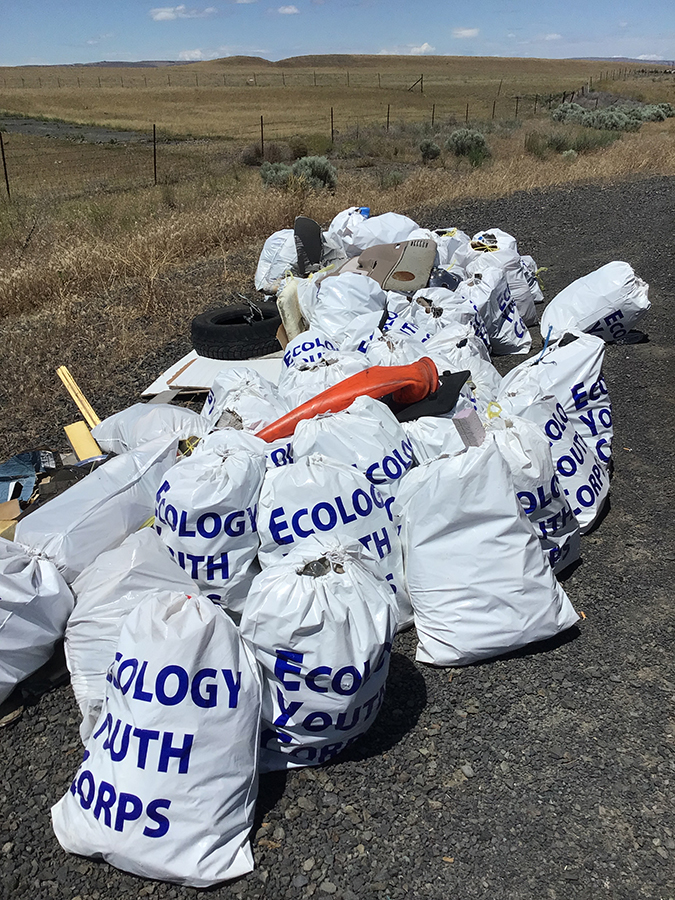
A typical litter cleanup job involves Ecology Youth Corps and adult crews bagging the litter and our crews collecting the bags and transporting them to landfills. In the first four months of 2023, crews have collected 1,648 tons (roughly 220,000 total bags) of trash. Our total for 2023 is only expected to increase as more litter pickup occurs across the state during warmer weather.

Department of Ecology Youth Corps collected a large amount of trash and other debris in eastern Washington this past summer and will be back
again this year across the state.

You may be wondering why the spike in litter totals this year? For the early part of the year there has been an increase in cleaning at encampments, including some of the work in Governor Inslee’s and the state Legislature’s Right of Way Safety Initiative to offer housing to the people living in state rights of way and close encampments. At times a site can’t be cleared because housing hasn’t been identified but our crews can still clean up the area and/or do regular trash collections to help keep trash from accumulating or spreading. While the amount litter collected near encampments is significant, it’s also important to note that historically it’s not the major type of trash we clear from roadways. Once crews are out in full force this spring and summer we expect to see significant increases in the overall litter totals we also report from other items such as leftover lunches to larger items like mattresses and desks (which pose safety hazards as well as adding to roadside litter). Essentially basic, every-day litter.

The spring and summer litter crews include the Ecology Youth Corps crews, who work in July and August and are paid roles. Ecology’s adult crews work from March to November and are paid roles as well. More information about Ecology’s work crews are available by clicking this link.

Along with Ecology, we contract with the Department of Corrections to hire inmates who choose to participate in the program to gain professional work experience, earn some money and give back to their communities while being supervised. Our contracts prohibit participants with serious offenses or security risks.

Here’s a look at the before and after of Department of Corrections work along I-5 near Tacoma.

Q: Most of the trash has to be from encampments near the highway, right?

A: In 2022, approximately 466 tons of trash was collected near encampments statewide. In 2021, that number was 166 tons – almost three times less. People living homeless on state rights of way is a far-reaching issue that can’t be resolved by a transportation agency alone. When addressing litter associated with an encampment, we remove the debris and hazardous waste after an encampment site has been vacated – and must rely heavily on other state agencies, non-profits, local jurisdictional and behavioral health partners before a site can be cleaned. (As mentioned above, we may also do regular trash collections at some sites waiting for housing to be identified). The outreach and planning work to connect people with social and medical services and other options is key to closing encampments long term versus just having people disperse to another outdoor location.

A look at litter under the SR 705 and I-5 interchange in Tacoma and after a contractor
cleaned the area in late January

As far as addressing encampments, our maintenance crews and contractors work to clean them and we also work with neighboring jurisdictions to coordinate large-scale cleanups like in Tacoma and Seattle. For January through April of 2023, our maintenance crews and contractors reported they’ve cleaned up a combined total of 1,453 tons of trash from encampments across the state. Some of our crews utilize contractors for encampment cleanups while other crews do the work themselves to reduce costs. To date, contractors have collected and disposed of 176 tons of our overall 1,453 tons from encampments.

Q: You’re not doing enough when it comes to litter. Can’t you just allocate more money to your maintenance budgets to focus on litter cleanup?

A: Along with the Department of Ecology, we spend a combined $12 million on litter cleanup annually. Even with such a large expenditure, the litter problem is constant and increasing at rates greater than our crews, volunteers and partners can reasonably collect. The main need is to prevent litter on our roadways and rights of way in the first place, which is why we have supported Ecology’s latest litter prevention campaign, Keep Washington Litter Free. This campaign includes messages on our highway reader boards, a robust social media campaign and seasonal litter emphasis patrols by the Washington State Patrol.

Highway signs show a variety of anti-litter messages throughout the year.

Highway maintenance work is prioritized and measured through a statewide accountability process based on funds allocated to us by the state Legislature and legal mandates we are obligated to meet for safety. In many cases we simply cannot defer critical maintenance work to focus only on litter – many of these other tasks are important for life/safety concerns. Roads must be cleared of ice and snow during the winter to keep people and goods moving. We also have thousands of miles of guardrail due for replacement and bridge decks that need repairs to extend their useful life. Our agency oversees approximately 18,700 lane miles, 3,300 state bridges and 120 miles of dedicated bike lanes across the state so there is a lot of work to do on a daily basis with limited funds.

Our roles in litter cleanup include:

  • Responding and removing any trash in active traffic or posing an immediate safety risk
  • Removing large items or debris (mattresses, couches) that potentially block traffic
  • Removing roadkill
  • Cleaning trash found near other roadside repair activities, as time allows
  • Collecting and disposing of all bags of litter collected from roadsides by Adopt-a-Highway volunteers, Ecology Youth Corps crews and Department of Corrections crews

We work hard to balance the needs of our aging transportation system while also addressing litter as time and resources allow.

Maintenance crews pick up trash bags and debris along westbound SR 8 near McCleary

Q: How did the COVID-19 pandemic affect litter pickup over the past few years?

A: Highway litter pickup was severely affected by the pandemic, including several litter cleanup programs put on hold due to safety and exposure concerns. That has led to an increase in highway litter. Due to COVID-19 safety restrictions, volunteer Adopt-a-Highway crews, the Department of Ecology Youth Corps and state and local departments of Corrections crews were not available for 2020 and parts of 2021 – meaning most of the “normal” highway litter cleanup did not take place or did so at reduced levels. Last year, due to the increase in trash after two years of a global pandemic, we increased our own litter duties statewide, while also focusing on graffiti removal, to help address the backlog.

Q: Why can’t you just fine people seen dumping furniture or trash bags along the highway?

A: The most important reason is we are not an enforcement agency and have no authority to issue citations. Enforcement on state highways is handled by the Washington State Patrol while local law enforcement handles other areas. Under state law, litter tickets and fines require the violation be witnessed by a sworn law officer. They cannot be issued based on reports given to or witnessed by our staff. Littering and illegal dumping are against the law in Washington. Fines range from $103 to $5,000. Many cities and counties have local ordinances that are stricter than the state law.

Q: There is a stretch of highway sponsored by a local business, and I don’t believe they are doing a good job at picking up the litter. How often do groups need to pick up trash to maintain good standing before possibly being removed?

A: There are two types of Adopt-a-Highway cleanup programs and they require a specific number of cleanings per year, rather than cleaning all litter as soon as it accumulates.

  • Adopted areas: These are areas adopted by volunteer groups, which could be a group of business employees, a family, a club, etc. The group receives an acknowledgement sign for their efforts. Groups must clean their sites a minimum of four times a year.

If an adopted location has not been picked for more than six months, local agency coordinators will contact the group leader and request they act with urgency. If a group is unresponsive or not compliant with their agreement, they are notified that their agreement will be canceled, their recognition sign removed and their section of road made available to another group for adoption. This rarely happens; however, we have had to make the decision to revoke an adoption. Some of our groups have been participating in the program for decades and take great pride in their work as valuable volunteers to Washington state.

  • Sponsored areas: For these sites a company partners with a state-approved contractor to clean a stretch of road – often areas where volunteers can’t operate due to safety concerns. The contract includes placing an acknowledgement sign recognizing the company’s efforts. The company’s name and logo – which must be reviewed by our agency -- also can only take up one-third of the entire sign. Federal law states the signs must be acknowledgements and not ads for the businesses – and they also cannot include details like addresses, phone numbers or hours of business.

Sponsorship contracts require six cleanings a year. If a sponsorship contract fails to meet their minimum cleaning requirements, the same follow up happens with the group as with adopted areas.

Adopt-a-Highway volunteers pick up litter along SR 99 in King County. We have
655 actively registered groups across the state

We need your help

Okay, we’ve answered some common questions we receive about litter but now have an ask of you – please help us keep Washington beautiful and litter free. We ask the public to:

  • Properly cover and tie down all loads, on all trips
  • Keep trash and debris securely gathered in vehicles until you reach home, so it doesn’t fall out or fly out of vehicles. The Department of Ecology provides free litter bags that are available for pick up at Fred Meyer locations throughout the year in Washington state.
  • Properly dispose of all trash; do not dump it at rest areas, parking lots or other land.
  • Share litter prevention messages with friends and family
  • If able, consider creating an Adopt-a-Highway group to join the valuable volunteers who help clear roadsides and other rights of way.