Monday, February 24, 2025

Planning a future to help relieve Gorst congestion

By Mark Krulish

Gorst gridlock’ is a trend we’d like to leave behind in 2024.

If you follow the latest trends on social media, you’ll see people sharing their 2025 “ins and outs.” Something we’d like to leave behind is the State Route 3 congestion in Gorst.

Traffic through SR 3 in Gorst is a challenge, to put it mildly. SR 3 and SR 16 are the only land-based state highways connecting the Kitsap Peninsula to the rest of the Puget Sound region. All roads literally lead to Gorst.

It’s also a complex area. There’s a Navy base nearby and a railroad crossing over SR 3. That makes it an important route for moving people and goods. We will also have to look at any barriers to fish along SR 3. We’ll also have to consider how any change in climate could affect the roadway.

But before we fully reimagine how travel through Gorst will look in the future, we’re undertaking a Project and Environmental Linkages study.

As they say it on social media, it’s so in!

This is an opportunity to hear from a lot of people. It allows us to get early input from local agencies, tribes, the United States Navy and you. This helps us better understand issues and priorities for all travelers before we draw up potential fixes. It also makes the environmental review process for any future projects much faster.

A wide view of Sinclair Inlet at the top of the picture surrounded by tree coverages on the edges. In the foreground towards the bottom, the curve where State Route 3 and State Route 16 meet can be seen.
Congestion on SR 3 and 16 in Gorst are significant for the entire region. Each highway is critically important for matters of national security, local commerce and freight.

How we got here so far

We developed a draft range of alternatives that aim to improve mobility along SR 3, SR 16, SR 166, and SR 304. The term “range of alternatives” is really just a fancy way of saying we’re looking at a wide variety of options.

We also create what’s called in engineer-speak a “Purpose and Need” statement. This statement is the foundation of the study. The statement explains the issues that we are trying to solve or reduce. The need includes supporting information that shows a problem exists or may occur. We then look at the alternatives to see which best fits our Purpose and Need statements.

A graphic that shows the study’s screening process. It begins with a wide range of different options. This is followed by a first level of screening for options that do not fit the needs of the area. Then the options are further refined before the study is complete.
PEL study alternative screening process.

The draft range of alternatives developed for this study takes an ‘everything but the kitchen sink’ approach. We want to start by considering every possible option and then narrow down to the best alternative(s) to study more in depth.

This is where you come in! We want feedback to help make sure you agree with Purpose and Need statement. This helps us make sure we’re on the right track. You also have the chance to weigh in on the different options we’re looking at.

Why don't you just build new lanes and get on with it?

It’s not that easy. Building, improving and maintaining state highways is extremely complicated. There are many factors that need to be considered. We need to take a measured approach to help ensure we hit our targets. We’re not just thinking about today, but decades from now.

The key routes are susceptible to liquefaction due to earthquake. There also is the potential for issues related to sea level rise caused by climate change. Just a few things we need to explore.

We want to hear from you

You have two options to provide your input at this stage of the study, through an in-person open house or an online open house. Both open houses will provide the same information in English, Spanish and Tagalog.

Join us for an in-person open house:

  • When: Wednesday, Feb. 26, from 4:30 to 6:30 p.m.
  • Where: Naval Avenue Elementary School gymnasium, 900 Olympic Ave., Bremerton, WA 98312
  • Details: You are invited to come ask our team questions and provide input on the Purpose and Need and Range of Alternatives. There is no formal presentation planned, so stop by any time.

Visit our online open house:

  • When: Now through Tuesday, March 11
  • Where: engage.wsdot.wa.gov/sr-3-gorst-area
  • Details: You are invited to visit and share your input virtually now through March 11.

Keep in touch

We are committed to keeping you informed throughout the PEL study. There are several ways to stay involved:

Monday, February 10, 2025

Is it a plane, drone, or UFO? Your questions answered here!

By: Eddy Hensley and Christina Crea

It’s a bird?… it’s a plane … it’s a UFO?… it’s… just a drone.

Lately, our Aviation UAS Program Coordinator Eddy Hensley has been asked about “unknown objects” in the sky, with some even asking if “they can shoot it down.”

No, you cannot shoot down a drone – that is a federal offense.

Also, please, never point lasers or bright lights at anything you see in the sky. It can disable pilots flying aircraft and is also a federal offense.

If you see drones, planes or helicopters with lights, they are on so they can be seen. It means that they are not trying to hide.

Most of the time, the drones, also referred to as Uncrewed Aircraft Systems (UAS), are just doing their jobs. Drone jobs are quickly growing for a variety of daily uses across our state and world.

An aerial image captured by a drone showing a road washout with mud and dirt in Washington state.
Aerial image of a washout captured by a drone in Washington state

We use drones in the inspection and maintenance of our critical infrastructure. One of our drones was recently used for graffiti removal. It can remove graffiti from our roads while adding safety for maintenance crews and roadway users and reducing the use of critical resources previously used for this purpose.

On the left is a drone hovering in the air. It has a spray nozzle attached and a mist of paint can be seen flowing toward the concrete wall on the right. The paint is covering graffiti tags.
A drone is used to paint over graffiti in a pilot program to test the potential for drones to serve this purpose.

Drones are also used for geotechnical surveys of slopes and roads throughout the state, where assessing stability of terrain and landslides is risky for our maintenance and geotechnical crews.

Future uses currently being explored include avalanche mitigation in our mountain regions and vegetation control on the sides of our roadways.

Two WSDOT staff use a remote control to fly a Skdio Drone in the sky near a bridge to practice for future inspections in Washington state.
WSDOT staff learn how to fly a Skdio Drone to use it for future bridge inspections in Washington state.

Here are some points to consider if you see a drone:

  • Most aerial phenomena can be explained. A large amount of content on social media shows planes, helicopters, drones, celestial objects and satellites.
  • Do not shoot guns, lasers or high-powered lights at flying objects. You may end up hurting someone in the air or on the ground. Either way, you are breaking both state and federal laws.
  • Seeing a drone does not mean it is doing something wrong. Drones are used by utility companies for inspection, by public safety responding to emergencies, law enforcements for accident reconstruction and for many other legal commercial and recreational activities.
  • Drones can fly at night. The Federal Aviation Administration (FAA) has rules that allow flights at night.
  • Do not confront drone pilots while they are flying their drones. It could pose a safety risk to bystanders. They are most often flying legally and safely. If you have a concern, contact your local law enforcement agency.
  • You can stay informed. There are flight phone applications for identifying recreational aircraft such as “FlightRadar24” for planes and helicopters or “Drone Scanner” for UAS. Be aware that not all aircraft or drones are required to broadcast their location. Also, the technology for drone Remote ID broadcasting is relatively new and may not be compatible with your personal electronic device.
  • If you feel a drone is operating illegally or not following FAA regulations, you should call local law enforcement or e-mail the FAA to report the sighting at 7-anm-sea-fsdo@faa.gov.

If you have any other questions regarding drones, contact Hensley at eddy.hensley@wsdot.wa.gov or 564-999-1040.

Friday, February 7, 2025

Brick-by-brick: The quest to get a custom Lego model on a ferry

By Brian Vail

Many of us spent hours playing with Lego bricks as kids, building buildings or designing towns in a form of puzzle-making. Local artist Wayne Hussey is a lifelong Lego lover and architect. One of his creations now lives aboard our ferry Issaquah. Getting it aboard was also quite a puzzle.

Lego model of a ferry named "Issaquah" in a glass display case with a wooden frame.
A Lego model of Issaquah is a new feature in the passenger cabin aboard the real Issaquah.

After working on the model for many years and completing it in 2001, Hussey recently donated his Lego Issaquah to us. Our own “connectors” at Eagle Harbor Maintenance Facility created a custom display case to house the 37,000-piece artwork. The ferry replica measures 7 feet long, 2.5 feet wide and 2.5 feet tall. They also made a brass plaque to honor the model.

Gold plaque with ferry outline, labeled "Washington State Ferries", on a polished wooden base with text reading Washington State Ferries "M/V Issaquah" LEGO Model Designed and Built By Wayne Hussey Donated 2025
The machine shop at our Eagle Harbor Maintenance Facility made a brass plaque for the display case.

From there, the Eagle Harbor staff had to figure out how to get the Lego and its display case safely onto the vessel. They decided the best time was January. That’s when Issaquah would be out of service undergoing maintenance. The next hurdle was to get the display up to the passenger deck. The display case was too large for the ferry’s elevator and wouldn’t fit up the stairs.

For help, the team turned to Bainbridge terminal employees, vessel maintenance staff and the crew working aboard Issaquah. They coordinated to have the boat make a pit stop at Bainbridge terminal. This terminal has an overhead walkway connecting directly to the passenger deck. The case was moved from a truck to a dolly and rolled aboard using the overhead walkway. The ferry then continued to Eagle Harbor, where the team positioned the model in the display case.

Lego model of a ferry displayed in a glass case, featuring vehicles on its deck.
A look at the car deck of the Lego Issaquah inside its display case. The vehicles alone are made up of over 2,000 pieces.

Hussey was thrilled to see the final product. When we announced the construction of our Issaquah-class ferries in the late 1970s, Hussey felt inspired.

“I had just entered my Lego hobby and saw the image as something that would make a really neat build challenge,” said Hussey. “It took about a year to plan it out and I completed my first design of it in December 1978.”

And his design incudes a detailed passenger deck and a stored rescue boat. The Lego replica can also be taken apart into three pieces to reveal the car deck.

Now, passengers can enjoy Hussey’s masterpiece while riding Issaquah. The real-life ferry just returned to service on our Fauntleroy/Vashon/Southworth route. The vessel is scheduled to move to our Anacortes/San Juan Islands run in late February, before returning to our “Triangle” route in the spring.

This unique Lego artwork is displayed alongside other custom ferry art and photos. These displays celebrate the rich history of Washington State Ferries. They showcase the creativity, stories and traditions that make us such an important part of our region’s culture and community, and an icon of the Pacific Northwest.

Thursday, February 6, 2025

Crews hope cameras can diffuse dangerous work zone conditions

 By Amy Moreno

Working in a highway construction zone is more dangerous than handling explosives – that’s what our worker Paul Jones says. He started his professional career in the oil and gas industry, sometimes working with explosives. He says road construction is by far his most dangerous job.

“With explosives, you have all these safety procedures. As long as you follow them, you’re fine,” said Paul, a construction compliance leader on the State Route 167 Corridor Improvements project. “When it comes to traffic, you can follow all the safety procedures and a drunk driver can still get you, even if you follow everything you’re supposed to be doing.”

That’s especially true given the increase in speeding and erratic drivers road crews and first responders have seen in recent years. That’s why we hope the new work zone speed cameras will help slow people down and keep everyone safer, including workers like Paul.

A person wearing dark jeans, orange high-visibility vest, and safety helmet stands between some equipment and a road. His vest is dirty like he's been working on something recently.
Paul Jones has done his share of dirty (and dangerous) jobs.

“It's hard to appreciate just how dangerous it is until you have these really close calls happening and it's like wow,” Paul explained. He’s worked on several busy freeways, which means he’s seen multiple collisions and near misses.

While doing survey work on SR 167 a few years ago, he asked a contractor to follow in a sign truck as an added layer of protection. “All the sudden, he blared the horn, and I dove left because traffic was to my right,” Paul explained. “Sure enough, somebody sick of traffic was coming right at me … if it weren't for that contractor hitting this horn, I wouldn't have seen the guy coming.”

Statistics to back those stories

This situation is more common than you might expect. A 2024 industry study found that nearly two in three contractors reported a crash in a construction work zone last year. In Washington, we average 1,345 work zone crashes yearly, which doesn’t even capture near misses.

In another crash, Paul said a driver slammed into a contractor’s truck so hard on SR 167 that his vehicle caught fire last year. Crews were later told the driver was distracted at the time of the crash. Fortunately, the contractor had just climbed out of the truck, heard tires on the rumble strips and had just enough time to jump over a guardrail.

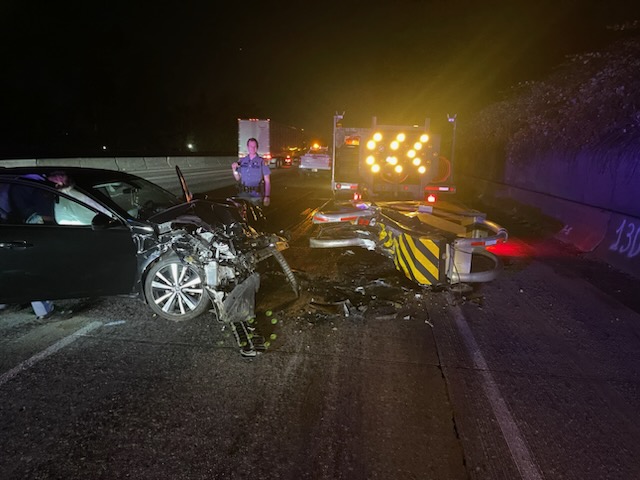
The results of a driver running into a work zone. The front of the car is smashed, and the protective device on the back of the work truck is also damaged.
Crashes in work zones are dangerous for workers, drivers, passengers and pedestrians.

“What if the contractor was still in his vehicle?” Paul asks. “What if he was getting out?”

Maintenance worker Sheri Knowles says that after nearly 15 years on the job, she has too many stories to count. Her family often worries for her safety: “My husband and my sons have a hard time when they see it on the news and social media.”

Sheri works traffic control and says she’s noticed increasing speeds and aggression in the last few years. “People are flying past us. Everybody’s tailgating and distracted with screens in their cars. Then, when they get to the work zone, they don’t have time to react.”

Work zone speed cameras

Workers like Paul and Sheri are part of the reason why WSDOT will soon unveil its work zone speed camera program. This new safety tool involves a partnership between the Washington State Patrol, courts, the Legislature, unions and industry supporters. The goal is to slow speeding drivers as they pass through work zones. Excessive speed is consistently among the top three causes of work zone crashes in our state.

The trailer-mounted cameras will rotate between construction, maintenance and emergency projects where speeding is a problem. Signs will warn drivers when a camera is in a work zone. When possible, radar speed feedback signs will also show drivers how fast they’re moving.

A small trailer, about 4 feet tall has a camera mounted to the top of it, pointed toward the adjoining road.
A trailer-mounted camera will be positioned in work zones where speeding is a problem.

There is no fine for the first work zone speed camera infraction, but it’s $248 for the second and every violation after that. Images of speeding vehicles will be forwarded from the camera vendor to WSP without any photos that show who was driving the vehicle. Troopers will screen and determine if a violation was committed. If it was, a notice will be sent to the vehicle's registered owner. People can acknowledge the infraction, pay the penalty, contest, appeal, ask for reductions or set up payment plans through a hearing.

The goal of the program is to slow drivers and protect workers and the traveling public. State statistics show that 95 percent of the people hurt in work zone crashes are drivers, their passengers or pedestrians. Any money generated by penalties goes only to support the program and fund safety education programs and DUI enforcement. This is a safety program and we’d be happy to see the program collect no fines – because no speeders mean safer work zones for all.

Legislation for the cameras took effect in 2023 with the program running until 2030.

Hope for a new type of work zone

Paul hopes the cameras change driver behavior like people have changed their driving near schools.

“We as a society really value taking care of our children,” he explained. “But we don't have that sort of civic responsibility and understanding regarding construction workers.”

The program starts with one camera in early 2025 and will increase to two more in the spring and as many as six by summer. We hope the cameras improve conditions for crews who just want to get home at the end of their shift.