Thursday, February 6, 2025

Crews hope cameras can diffuse dangerous work zone conditions

 By Amy Moreno

Working in a highway construction zone is more dangerous than handling explosives – that’s what our worker Paul Jones says. He started his professional career in the oil and gas industry, sometimes working with explosives. He says road construction is by far his most dangerous job.

“With explosives, you have all these safety procedures. As long as you follow them, you’re fine,” said Paul, a construction compliance leader on the State Route 167 Corridor Improvements project. “When it comes to traffic, you can follow all the safety procedures and a drunk driver can still get you, even if you follow everything you’re supposed to be doing.”

That’s especially true given the increase in speeding and erratic drivers road crews and first responders have seen in recent years. That’s why we hope the new work zone speed cameras will help slow people down and keep everyone safer, including workers like Paul.

A person wearing dark jeans, orange high-visibility vest, and safety helmet stands between some equipment and a road. His vest is dirty like he's been working on something recently.
Paul Jones has done his share of dirty (and dangerous) jobs.

“It's hard to appreciate just how dangerous it is until you have these really close calls happening and it's like wow,” Paul explained. He’s worked on several busy freeways, which means he’s seen multiple collisions and near misses.

While doing survey work on SR 167 a few years ago, he asked a contractor to follow in a sign truck as an added layer of protection. “All the sudden, he blared the horn, and I dove left because traffic was to my right,” Paul explained. “Sure enough, somebody sick of traffic was coming right at me … if it weren't for that contractor hitting this horn, I wouldn't have seen the guy coming.”

Statistics to back those stories

This situation is more common than you might expect. A 2024 industry study found that nearly two in three contractors reported a crash in a construction work zone last year. In Washington, we average 1,345 work zone crashes yearly, which doesn’t even capture near misses.

In another crash, Paul said a driver slammed into a contractor’s truck so hard on SR 167 that his vehicle caught fire last year. Crews were later told the driver was distracted at the time of the crash. Fortunately, the contractor had just climbed out of the truck, heard tires on the rumble strips and had just enough time to jump over a guardrail.
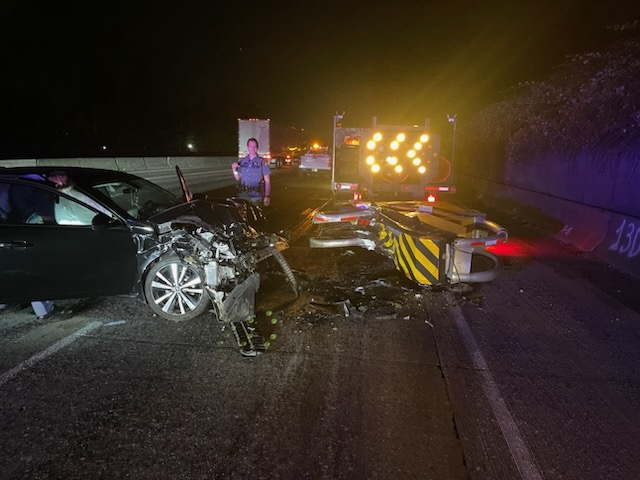
The results of a driver running into a work zone. The front of the car is smashed, and the protective device on the back of the work truck is also damaged.
Crashes in work zones are dangerous for workers, drivers, passengers and pedestrians.

“What if the contractor was still in his vehicle?” Paul asks. “What if he was getting out?”

Maintenance worker Sheri Knowles says that after nearly 15 years on the job, she has too many stories to count. Her family often worries for her safety: “My husband and my sons have a hard time when they see it on the news and social media.”

Sheri works traffic control and says she’s noticed increasing speeds and aggression in the last few years. “People are flying past us. Everybody’s tailgating and distracted with screens in their cars. Then, when they get to the work zone, they don’t have time to react.”

Work zone speed cameras

Workers like Paul and Sheri are part of the reason why WSDOT will soon unveil its work zone speed camera program. This new safety tool involves a partnership between the Washington State Patrol, courts, the Legislature, unions and industry supporters. The goal is to slow speeding drivers as they pass through work zones. Excessive speed is consistently among the top three causes of work zone crashes in our state.

The trailer-mounted cameras will rotate between construction, maintenance and emergency projects where speeding is a problem. Signs will warn drivers when a camera is in a work zone. When possible, radar speed feedback signs will also show drivers how fast they’re moving.

A small trailer, about 4 feet tall has a camera mounted to the top of it, pointed toward the adjoining road.
A trailer-mounted camera will be positioned in work zones where speeding is a problem.

There is no fine for the first work zone speed camera infraction, but it’s $248 for the second and every violation after that. Images of speeding vehicles will be forwarded from the camera vendor to WSP without any photos that show who was driving the vehicle. Troopers will screen and determine if a violation was committed. If it was, a notice will be sent to the vehicle's registered owner. People can acknowledge the infraction, pay the penalty, contest, appeal, ask for reductions or set up payment plans through a hearing.

The goal of the program is to slow drivers and protect workers and the traveling public. State statistics show that 95 percent of the people hurt in work zone crashes are drivers, their passengers or pedestrians. Any money generated by penalties goes only to support the program and fund safety education programs and DUI enforcement. This is a safety program and we’d be happy to see the program collect no fines – because no speeders mean safer work zones for all.

Legislation for the cameras took effect in 2023 with the program running until 2030.

Hope for a new type of work zone

Paul hopes the cameras change driver behavior like people have changed their driving near schools.

“We as a society really value taking care of our children,” he explained. “But we don't have that sort of civic responsibility and understanding regarding construction workers.”

The program starts with one camera in early 2025 and will increase to two more in the spring and as many as six by summer. We hope the cameras improve conditions for crews who just want to get home at the end of their shift.


Thursday, January 30, 2025

"Why did the pass close?" Common triggers behind winter pass closures and what we do to get the roads back open

 By: Scott Klepach and Lauren Loebsack

You can count on three things to happen every winter in Washington: Long nights, short days and closed passes.

Some mountain passes – like SR 20 North Cascades Highway, SR 410 Chinook and SR 123 Cayuse – close for the season. Others, like I-90 Snoqualmie Pass and US 2 Stevens Pass require year-round work to remain open for winter travelers.

: A snowplow on a clear mountain road facing a vibrant sunrise and snow-covered mountains.
Clear roads ahead on Christmas morning on Stevens Pass.

During the warmer months, Snoqualmie and Stevens crews repair roads, prepare equipment and make improvements from last winter’s wrecks. Once winter arrives, their focus turns to snow and ice operations.

But even with all this preparation, sometimes the weather, avalanche control or crashes cause a pass to close. Let’s look at what causes closures and how crews work to get roads open again.

What triggers a pass closure?

Pass closures happen every winter. In most cases, closures happen because drivers aren’t prepared for the conditions.

“It’s the (drivers) failing to follow traction requirements and speed limits,” said maintenance superintendent Jason Pratt, who has worked 17 winters in WSDOT’s maintenance area 1 in South Central Region, which oversees Snoqualmie Pass. “That’s what causes most of the closures. Our team is the best in the business. We know how to handle a storm.”

Pratt adds that safety risks and traffic issues come from drivers who don’t have good tires, drive too fast or don’t know how to drive safely in snow and ice. Some people ignore the chain-up rules or simply don’t know how to use chains.

Trucks and an emergency vehicle on a snow-covered road with a mountainous, forested background.
In this scene from December 2020, multiple semi-trucks failed to chain up, got stuck and closed Snoqualmie Pass for more than an hour. Closures of this nature happen every winter.

This is also true on Stevens Pass, where weather-related closures are rare. Only three closures in the last five years were due to weather conditions. But that doesn’t mean the pass is always bare. During and directly after snowstorms, roads may have snow or compact snow and ice on the road, which is why it’s important for drivers to be prepared before they head out.

“Usually, we have to close because someone didn’t check the forecast, or thought they could get across the pass on bad tires,” said Aaron Byrd, maintenance supervisor for Stevens Pass. “My advice is check the pass report. We update at 7 (a.m. and p.m.), 11, and 3, day and night. That’s our crew out on the pass, reporting conditions in real time.”

Working quickly – and safely – to reopen

One spin out can close an entire pass for hours. During that time, Incident Response, Highway Maintenance and other first responders and tow truck operators work together to clear vehicles or debris. If there’s a big crash or if material is spilled onto the roadway or waterways, the cleanup can take even longer.

“Our crews work as quickly and safely as possible to reopen a highway,” Pratt said.

We work closely with Washington State Patrol to safely close the roads. Our crews use special trucks called “push pickups” to push vehicles out of the way and to the shoulder. When we need to move a large vehicle like a semi-truck, we need to call in big tow trucks that come from further away, which adds more time.

Crews work from the top of the summit to clear snow, but plows can’t get through if there are vehicles blocking the road. All of this takes time and resources to shift crews to the greatest needed area for storm response.

“This is what crews try to do with vehicles – move blocking vehicles to just try and get traffic flowing again,” said Scott Montgomery, maintenance supervisor at Snoqualmie Pass.

When weather-related closures are necessary, it isn’t a quick process. Our crew “sweeps” the road, traveling the area between the closure points to clear traffic.

A snow blower clearing a snowy mountain highway beneath two signs that read: Exit 53 East Summit 1 mile and Exit 52 West Summit ½ mile.

On Stevens Passs, we coordinate with the ski resort to assist skiers down the mountain. Depending on the severity of conditions, skiers have had to travel east toward Leavenworth and double back around on US 97 Blewett Pass to get home.

Closure points are staffed, unless it’s expected to be a longer closure – for example longer than 24 hours – in which case, the crew will build a snow berm at the closure points to prevent drivers from trying to sneak through the closure.

Working with the weather

Before a snowstorm, crews might close a pass to conduct avalanche control – which can take from 30 minutes to two hours to complete depending on how much debris comes down.

“Avalanche missions are a delicate balance,” said Harlan Sheppard, North Central Region avalanche supervisor. “(Do them) too often and you don’t get results that are worth the cost, not often enough and it could be tipping over into avalanche danger.”

During avalanche control missions, traffic is held on either side of the summit while crews use explosives to trigger avalanches. The maintenance team follows the avalanche control team, using loaders, blowers and plows to clear the road. Even though the closures can be short, the team typically schedules missions for early in the morning – when there’s usually the least amount of traffic.

Snowplows clearing a snowy road in a mountainous area with trees and rocky hills.
Snowplows clear snow from Stevens Pass following an avalanche control mission.

We’ve also installed defensive strategies to keep falling snow off the roads. Across the summit of US 2 Stevens Pass, structures referred to as “passive protection” are designed to lessen the potential for snow slides to reach the highway.

Deflection berms, like the one constructed in 2019 at Tunnel Creek, and gabion baskets such as those installed at East Portal and Tunnel Point are defensive strategies to collect and redirect snow. They also work to catch debris such as rocks that come down year-round.

Once snow begins to fall, crews build snow trenches in areas know to have smaller slides, shaping the piled-up snow on the side of the road into a basin that can then be cleaned out.

Defensive measures have also been implemented at Snoqualmie Pass. As part of the I-90 Snoqualmie Pass East project to enhance the highway between Hyak and Easton, crews constructed avalanche bridges east of the summit, positioned over sections of the road prone to avalanche risk. Instead of allowing snow and debris to fall directly onto the road, the bridges allow the snow to pass underneath, essentially diverting the avalanche away from the highway. This prevents road closures and reduces the risk to motorists. However, avalanche control work is still needed west of the summit.

How can I prepare for winter driving across the passes?

Winter preparation messaging can seem excessive until drivers are in a serious winter storm.

“It’s why you really need to understand and be prepared for winter travel,” Byrd said.

Here’s how you can do your part to be prepared for whatever you encounter during a winter drive across the passes:

  1. Be prepared for possible delays and ensure you carry appropriate winter travel gear.
  2. Stay informed . Check weather and conditions before you leave and during travel – if you are driving, never check from behind the wheel, pull over to a safe spot or ask a passenger to check. Use WSDOT’s tools to stay informed of conditions and possible closures.
  3. Drive for the conditions : Slowing down and leaving plenty of following distance for other drivers and plows help reduce the potential for collisions and spin outs that are the primary reason the pass closes.
  4. Carry chains. Requiring chains be installed in certain conditions allows travelers to continue moving during storms rather than closing a pass or roadway. If you haven’t before, look into getting chains or traction alternatives recommended for your vehicle. Practice installing chains at home or driveway. You do not want to install chains for your first time along the side of a highway during a winter storm.
  5. Always expect winter travel conditions. Drive knowing and expecting that snow and ice conditions could be present. Roads that appear wet could be black ice.
  6. Even if you don’t see them, our crews are out there. Plows must travel slow and often are plowing other roads or sections of highway if you don’t see them while driving. Our crews take great pride in their work. Many live in the areas that they work.

Know before you go

Monday, January 27, 2025

The One Where We Revive I-5 (just a little later than planned)

By: RB McKeon

A still from the TV show "Friends" where two people are trying to move a couch past a stair landing. Text over the image says PIVOT!

Ok, so maybe this won’t be the most famous “PIVOT!” in history, but it’s a big one and we want to share all the details with you about some important changes to the Revive I-5: Yesler to Northgate project.

What’s happening?

Let’s cut right to the chase. We originally planned to begin major preservation work on Interstate 5 on the Ship Canal Bridge (just north of downtown Seattle) in March 2025. The long-term lane closures and critical preservation work on the I-5 Ship Canal Bridge is now expected to begin in 2026.

We are actively working with our contractor to refine the project to align construction spending with available funding and balance long-term preservation needs while minimizing the impacts to the public.

… and let’s just say up front, that in support of Seattle’s success as a 2026 World Cup host city, all lanes of I-5 will reopen to traffic for several weeks starting in early-June 2026 and will resume in mid-July 2026, once Seattle area World Cup matches have concluded.

Why the change?

The decision to adjust the schedule and scope of the project comes as WSDOT works to align construction spending with available budget. A significant gap in funding, driven by changes in the financial environment, meant that the original plan would exceed budget projections. By focusing the scope of the project to our top priority – preserving the Ship Canal Bridge deck – we can balance the immediate needs of the I-5 corridor with what can be accomplished within our current financial constraints.

This shift also gives us more time to work with our community and business partners to prepare for future closures. We are committed to providing regular updates as the details of our new plan are available.

What does this mean for travelers?

Although the months-long double-lane closures are postponed until 2026, travelers can still expect some traffic impacts this year, including overnight work, weekend closures, and possible lane reductions. In 2025, our contractor may work to accomplish things that can be done without long-term lane closures and that will support the work we have shifted to 2026. We’ll continue to keep the public informed with real time updates via our travel map, email newsletters and social media channels.

2026 FIFA World Cup

With Seattle set to host FIFA World Cup matches in 2026, and thousands of visitors coming to Washington we’ve committed to not implementing long-term lane closures or full closures on I-5 during the World Cup matches in Seattle and Vancouver B.C. This decision will allow for smoother travel and keep our roads open for fans and visitors from around the world.

We acknowledge that with the delay in starting this project, there are risks of emergency repairs causing disruptions leading up to and following World Cup. But, rest assured, we’ll continue to monitor the situation and take action as needed to keep I-5 operational.

Bridge deck repairs during the delay

While we are adjusting the timeline for major preservation work, we will continue to prioritize the rehabilitation of the Ship Canal Bridge as our first order of business.

Our contractor is prepared to address any emergency needs quickly, just as our WSDOT maintenance crews have.

It is important to note that the bridge’s integrity is not compromised and that while this work is critical, this is about rehabilitating and preserving the bridge deck, or the roadway surface, not the bridge structure.

Emergency repairs on the Ship Canal Bridge for deck repair are not uncommon. Since 2019, nearly 200 emergency repairs have been made. And given the current condition of the bridge deck, we are likely to continue to need to fix failing expansion joints, fill large potholes or make other emergency repairs.

Working together to keep you informed

There’s no perfect time to carry out the extensive preservation work needed on I-5, especially considering its current condition. The region is already juggling multiple large-scale transportation projects, the upcoming FIFA World Cup, a return to pre-COVID traffic levels, major events and more. But the good news is this pivot gives us more time to communicate and collaborate with our partners, businesses, and communities.

We’ve been working with key transit partners for over two years in preparation for this project, and we’ll continue to work closely with them over the next year to ensure the region is ready for this critical work.

Once negotiations with our contractor are complete and key details of the revised plan are confirmed, we’ll focus on tried-and-true communication tools to make sure the public and our partners can “Know Before You Go.” This will include targeted outreach to Environmental Justice communities to ensure their needs are considered and they’re fully informed about how this work may impact their travels.

We’ll continue to work closely with our regional partners to spread the word, leveraging their existing channels and relationships to ensure as many people as possible are informed and prepared. This way, no matter where you are or how you choose to travel, you’ll have the information you need to plan ahead.

Beyond the pivot

This pivot is the best path forward, and it’s what’s needed right now. The work on the Ship Canal Bridge remains our primary focus, and it’s an important step in a much larger effort to Revive I-5. It may not be easy, and there are still challenges ahead, but this approach ensures we tackle the most urgent needs first.

Looking ahead, we’re setting the stage for long-term work to preserve the lifeline that I-5 has become for our region. We know that I-5 connects people to their jobs, families and communities, and it keeps our economy moving. That’s why, even as we focus on this critical work now, we’re already planning for the next steps to keep the entire corridor safe and reliable for generations to come.

We’re committed to working closely with you to ensure this vital work is done right. Together, we’ll get through this, and in the end, I-5 will be stronger and more resilient than ever.


Thursday, January 16, 2025

Fare-free transit boosts youth use of public transportation

By Mathew Willoughby

A group of kids on a bus.
Seventh graders riding a Whatcom Transit Authority bus home from school.

It’s now easier for kids to ride public transportation than ever before. Why? Because it’s free!

In 2021, lawmakers helped transit agencies get rid of fares for youth 18 and under. As a result, kids took nearly 15 million trips on public transit in 2023. If you include rides on Washington State Ferries, that number shoots up to a whopping 16.5 million.

Youth can now go to school, get home, hang out with friends and not pay a dime. Kids don’t have to depend on someone else for their rides if they don’t have the money. Even better, families no longer have to set aside income for bus rides for their kids.

To get kids eager to ride the bus and take advantage of this new program, transit agencies in Washington and their partners used after-school field trips, social media posts and in-school presentations.

Don't know how to ride the bus? No problem! Our partners even stepped up to the plate to teach kids how to navigate confusing bus routes. Now, youth have greater access to what our state has to offer.

Student loads bike on front of bus.
A student loads their bike onto the bus rack after school, ready for their free ride home.

Spreading the news

The results speak for themselves at King County Metro. To help get the word out, they launched the Free Youth Transit Pass program in 2022. In the program's first year, kids took over 7 million rides. But they didn’t accomplish this feat alone. They partnered with eight public transportation providers and our very own Washington State Ferries to pull this off.

King County Metro and its partners used TV ads, in-person events and the internet to get the word out. Their outreach got an average of 990 people to visit FreeYouthTransitPass.com daily. This was a 700 percent increase in visits than when they weren't directly reaching out to youth. Through working with their partners, they got kids eager to explore public transportation.

With more kids interested in taking advantage of this exciting program, King County Metro makes sure kids know how to use public transit safely and reliably. They come directly to the classroom to teach students all about bus safety during their education program. They even provide educational safety videos for grades 2-5 and 6-12 free for anyone to watch.

Further north in Whatcom County, the Whatcom Smart Trips program has been inspiring students to ride public transportation for over five years. The program teaches students how to safely and reliably use public transit at a young age. Now that kids can ride the bus for free, they are one step closer to achieving their big goal: Getting every seventh grader in the county to ride the bus at least once!

But why seventh graders? This bunch is too young to drive, and they depend on someone else for a ride unless they can walk, bike or ride the bus.

“Each year we find students to be more eager to ride the bus than the year before. Faces light up when suggested destinations are shared in our presentations,” Whatcom Smart Trips Program Manager Michelle Grandy said. “They’re especially excited when they learn the bus is free for them to ride.”

After students complete the program, Whatcom Smart Trips sees more kids on the bus. Now, instead of waiting for a ride to go home or hang out with friends after school, students can ride the bus for free.

These are just two of the many stories about improving access for everyone in Washington from our annual 2024 Public Transportation Mobility Report. In the report, you can read about the programs, partners and plans that work to bring people together through access to public transportation. Interested in getting into the data? Check out our annual 2023 Summary of Public Transportation.

Two people riding the bus.
Riders on the Cheney High Performance Transit Line.

For generations to come

Teaching kids how to safely and reliably ride the bus creates a new generation of public transportation riders. That means fewer drivers on the road, fewer carbon emissions and more access. Without our public transportation grants and Washington’s Climate Commitment Act, programs like this would not be possible.

Along with free rides, our funding gives kids (and grownups!) more access to jobs, healthcare, food and community in rural and urban areas.

And it's not only buses and city and county transit services: free youth fare started at Washington State Ferries in October 2022 and on Amtrak Cascades this past summer. Nearly 11,000 youths benefitted from fare-free trips on Amtrak Cascades between June (when the program was implemented) and August 2024. Implementation on Amtrak Cascades service was delayed while Amtrak updated its national ticketing system to align with the fare-free program.

Youth under 18 using public transit for free is an exciting milestone for the industry in Washington. We look forward to this new generation of bus, ferry and train riders.