Wednesday, July 31, 2024

SR 165 Carbon River Bridge highlights preservation challenges in our state

Update: 5 p.m. Tuesday, April 22, 2025

On Tuesday, April 22, 2025, the Washington State Department of Transportation announced the permanent closure the 103-year-old State Route 165 Carbon River Fairfax Bridge.


Update: 3:30 p.m. Monday, April 14, 2025

On Monday, April 14, 2025, the Washington State Department of Transportation closed the State Route 165 Carbon River Fairfax Bridge to all vehicle and pedestrian traffic until further notice.


By Cara Mitchell

View from underneath a bridge stretching over a wooded canyon. The bridge is made of wood and steel. Some of the supporting steel beams below the bridge have rust on them.
The Carbon River Bridge on State Route 165 is also called the Fairfax Bridge.

It's a sign of the times. On Friday, July 26, our state bridge engineers had to further limit the types of vehicles that can use the 103-year-old Carbon River/Fairfax Bridge in Pierce County.

The new weight limit is 8 tons, or 16,000 pounds. Anything over that weight limit can no longer cross the bridge. This is the third restriction we've had to place on the bridge since 2009. In 2013, commercial vehicles were restricted crossing the bridge.

We know the latest restriction is especially tough for people who live south of the bridge. There is no detour available. We are working with private property owners and signed an emergency declaration with the hopes we can create an emergency detour access route for locals and first responders.

What changed on the bridge

The 494-foot-long bridge has been inspected every two years by state bridge engineers. This spring, engineers rappelled down the side of the bridge to measure the condition of the bridge's steel components. They used this data to calculate the revised load rating.

Left: A closeup view of a bridge steel beam with weathered paint. The steel is rusted where the paint has chipped off. Right: A closeup view of a bridge steel beam with severely weathered paint. The steel is rusted and degrading where the paint has chipped off.
Photos from 2022 and 2024 show the advancing deterioration of steel sections of the bridge.

The center portion of the bridge is built out of steel, while the bridge approaches are timber. Steel deteriorates over time as it's exposed to rain or snow. Water on steel over time forms rust, which weakens the steel. We combat rust on bridges by painting them. The last time the bridge was painted was in 1988. Since then, we have repeatedly recommended this bridge as a candidate for replacement due to its overall condition and age. In 2023, it was removed as a candidate for replacement due to funding constraints.

As of June 2023, 55 steel bridges were due for painting, 47 were past due and six were being painted. Decades of underfunding maintenance and preservation has resulted in a backlog of work needed keep our transportation system in full operation. We do our best with the funding we are given by the Legislature. We continue to work with state leaders to communicate our needs and the risks associated with those needs being unmet.

Will the bridge be replaced

Deferred preservation has been an ongoing issue for years. Prior budgets passed by the Legislature have not provided funding to replace or make repairs to the bridge, and the SR 165 Carbon River/Fairfax Bridge is now a tangible example of a much larger issue in our state. Without more investment in preservation, we will continue to see more bridges weight listed, longer detours (where applicable) in place and highways with "rough road ahead" signs.

The bridge is competing with other aging bridges across the state. As of June 2023, 315 of our 3,384 bridges were 80 years old or older, accounting for 9.3% of all state-owned bridges. Factors such as traffic volumes play into which bridge rises to the top of the list for replacement.

Our bridge maintenance teams have done their best to keep the bridge in good working order. As an example, we replaced sections of a failing wooden bridge deck last May.

Left: View from the top of a wooden bridge deck during repairs. Pieces of old wood are missing from the bridge deck. Right: A bridge maintenance worker in an orange vest and white hard had installing new wooden panels on a bridge deck.
Olympic Region bridge maintenance crew members replacing aging wood bridge deck panels
on the bridge on May 16, 2024

Because of the new load rating, our crews will increase the frequency of inspections on the bridge to every six to 12 months.

We know there are some who will say, "the Brooklyn Bridge is even older and it's still open." This is true. Hundreds of millions of dollars have been spent to keep that historic bridge in good working order. That hasn't happened in Washington state.

Typically, a bridge has a service life of 75 years, based on current standards. In Washington, the average age of state-owned vehicle bridges is 51 years. At age 103, our Carbon River Bridge has held up well. That's in large part because of dedicated bridge engineers who routinely inspect the bridge and bridge maintenance crews who make repairs. The bridge was built in 1921 for $500,000. According to History Link, it was the tallest bridge at the time in the state. Over 100 years later, there are very few highway construction projects, let alone a bridge, that cost $500,000. For instance, we just opened a new bridge in Clallam County that replaced another almost 100-year-old bridge to the tune of $42 million.

New signs and changes to intersections: What travelers need to know

New weight limit signs for the bridge are on order and we are moving quickly to install them.

The bridge is in a rural area with little room to turn around so we're putting advanced warning signs on roads leading to it. You'll soon see signs on SR 165 leading up to the bridge from SR 162, Wilkeson and Carbonado. Those signs are meant to catch the attention of anyone who is driving anything over 8 tons before they get to the bridge.

We're also making some changes to the intersection of SR 165 and Pershing Avenue in Carbonado. The intersection will become an all-way stop. The same goes for the intersection of SR 165 (Mowich Lake Road) and Carbon River Road. The all-way stops will allow drivers another chance to stop, change direction, and make informed decisions prior to crossing the weight-restricted bridge.

What vehicle weighs 8 tons?

Knowing how much your vehicle or the load you're pulling weighs is always important.

  • 1 US ton equals 2,000 lbs.
  • 8 US tons equals 16,000 lbs.

The bridge is closed to any vehicles that exceeds the maximum weight limit of 16,000 lbs. (8 tons). Official vehicle weights might be found in your vehicle's manual or inside the driver's side front door. Some vehicle registrations will also include this information. There are also fee-based weigh stations that you can use to weigh your vehicle.

A quick Google search shows us that a 2024 Subaru Forester weighs around 3,528 pounds, empty. A Ford F-150 has a curb weight up to 7,000 pounds. Full size RVs can range from 10,000 pounds to 30,000 pounds depending on make and model. Your mid-size SUV will likely be ok to cross the bridge, but better check the weight of the pickup or RV you're driving or pulling before you go. Keep in mind, drivers must add the weight of fluids, loads and people traveling in the vehicle to determine if the vehicle is over the gross weight restriction.

Stay informed

We will share more information with our community partners and property owners in the coming weeks. People can sign up to receive updates on the SR 165 Carbon River Bridge through GovDelivery.

Information line about the bridge is available at: (360) 704-3268

For real-time travel information, visit wsdot.wa.gov and search WSDOT Travel Map and WSDOT Mobile App.

Thursday, June 13, 2024

Galloping Gertie’s replacement is a Boomer, and it needs work

By Cara Mitchell

You’ve likely seen the memes about Boomers, Gen X, Millennials and Gen Z.

We have a new one for you, and it involves two bridges across the Tacoma Narrows:

Photo of Tacoma Narrows Bridge with Gen Z vs Boomer text overlay

Our 1950 westbound bridge, from Tacoma to Gig Harbor, is a Boomer.

The 2007 eastbound bridge, from Gig Harbor to Tacoma, is a Gen Z.

One is 74 years old while the other is still virtually a teenager.

In recent years, we’ve seen issues with our aging westbound bridge. The most recent episode was in mid-May when an expansion joint required us to reduce the bridge from four to two lanes for several days.

In late May, we discovered more issues on the same bridge involving a type of expansion joint called a finger joint. It is called this because it resembles a finger on a hand. These joints allow the bridge to expand and contract. The parts to fix it took a few weeks to be custom manufactured. You can’t order these parts off Amazon.

Photo of a cracked finger joint on the westbound Tacoma Narrows Bridge
Photo shows a cracked finger joint on the westbound Tacoma Narrows Bridge.
The finger joint will be repaired June 15-16, 2024.

The repairs this time mean the westbound SR 16 Tacoma Narrows Bridge will be reduced from four lanes to two from 4 a.m. Saturday, June 15, to 4 p.m. Sunday, June 16.

Image of Robert Downey Jr. as Tony Stark rolling his eyes
Real-time reaction from travelers reading that there’s more repairs on the way

Fortunately, this work could be scheduled over a weekend when there is less overall traffic. That won’t always be the case. Based on the age of the bridge, we know more emergency closures are in our future.

Years of underfunding both our highway Operations & Maintenance and Preservation programs have put our transportation system in jeopardy. Our highway maintenance crews provide short-term repairs like filling a pothole. Longer-term preservation work like roadway surfacing or bridge deck rehabilitation extends the life of our infrastructure. Both programs are needed to work in concert with one another. Unfortunately, given the number and age of our bridges, there is just not enough dedicated funding to keep them from developing age-related problems.

Tacoma Narrows Bridge crew members working under the bridge deck, fabricating forms
to pour new concrete during the emergency lane closures in May.

Lengthy repair list keeps growing

The westbound Tacoma Narrows bridge is one of the largest in our state bridge inventory. Given its age and how heavily it is traveled (45,000 vehicles each day, on average), it has a long list of repair needs including:

  • Replacement of expansion joints
  • Mechanical repairs of the elevators in the towers
  • Emergency electrical system supply upgrades
  • Rehabilitation of the superstructure damping mechanisms at the towers
  • Various structural repair needs throughout the bridge, such as tightening nuts, addressing rust and corrosion, replacing damaged rivets and bolts and replacing damaged structural members.
  • Fully removing and replacing the paint at the towers, trusses, cables and suspenders.

We have a preservation project designed to fix expansion joints on the westbound bridge that will extend the useful life of the bridge. The not-so-good news is that the project is delayed because we don’t have the funds to do the work. The earliest this project can now occur is 2026.

About those tolls

Before you type in all caps “whatabout those tolls,” a reminder that tolls don’t pay for maintenance on the westbound Tacoma Narrows Bridge. Tolling on the eastbound SR 16 Tacoma Narrows Bridge helps repay the costs to build the eastbound bridge, which opened in 2007. Tolls are only collected for trips headed to Tacoma, and toll rates are a fixed rate no matter when you travel. The Washington State Transportation Commission adopts state highway tolls.

Years of underfunding Operations & Maintenance and Preservation is catching up

Not having the funding we need means hard choices are made. Legally, we can’t overspend our budget. That means the agency must decide and prioritize which maintenance activities and preservation projects need to be delayed to stay within the budget we have. This is just like the tough choices people make with their personal budgets.

This is happening with the 1950 Tacoma Narrows Bridge and hundreds of other bridges and highways across the state. As of June 2023, 315 of our 3,384 bridges were 80 years old or older, accounting for 9.3% of all state-owned bridges. The number of WSDOT-owned bridges in poor condition increased 7% from 199 bridges in June 2022 to 213 in June 2023.

Washingtonians own a multimodal state transportation system that would cost nearly $200 billion to replace, but we’re not spending what we need to keep that system in good working order. This isn’t new information, and something our Secretary of Transportation and other agency executives have shared regularly with elected officials, local governments and other partners over the last eight years.

Both the Operations & Maintenance and Preservation programs aren’t about adding new things. Rather, they each play a role in taking care of what we already have.

For example, funding in the Operations & Maintenance program supports repairing potholes repairs, patching bridge deck patches and recent emergency closures on the westbound Tacoma Narrows Bridge. Planned preservation work, such as resurfacing a roadway or rehabilitating all the bridge joints in one project, are needed investments to keep the transportation system running smoothly.

Think of it like taking care of the roof on your house. Getting grime out the gutters and annual cleaning, that’s maintenance. Putting new shingles on, that’s preservation. You can clean a roof with old shingles and replace the shingle that is in bad shape. But, if you don’t put new shingles on your roof, eventually it will deteriorate over time and cost even more to fix down the road.

Maintenance crews holding things together

Photo of a Tacoma Narrows Bridge crew performing inspections high on the bridge
Tacoma Narrows Bridge crews perform inspections and
maintenance every week on both bridges

Our dedicated maintenance crew performs weekly detailed inspections and maintenance for both bridges. They identify, troubleshoot and address the many items needed to keep travelers moving. Their work is essential to the safe operations and extended service life of these bridges.

A separate team, our Bridge Preservation Office, also performs various engineering inspections (routine, in-depth, underwater, mechanical, electrical, structural) at set 1-year, 2-year, and 5-year intervals.

The point: we aren’t neglecting the bridge. It’s aging, and temporary fixes only go so far.  The team that cares for this bridge takes a lot of pride in their work. They strive to keep this span in the best condition they can. And it’s important to share this information so travelers understand what we are all facing.

More lane closures and extended drive times

There is never a good time to close lanes on the westbound bridge for emergency repairs. We know the weekday evening commute becomes brutal when this happens.

It wasn’t that long ago when there was only one bridge, and travelers had to plan an extra hour to cross the Tacoma Narrows during rush hour.

 So, why can’t we just move traffic to the other bridge during rush hour like Seattle’s Express Lanes?

While this seems straight forward, it isn’t as easy as it sounds.

Switching directions of travel across the State Route 16 Tacoma Narrows Bridge is possible. We designed it to work that way. But it works best for long term events. We did it in 2016 when the bridge decks were re-paved.

Putting this into place requires miles of traffic control barrels, reflective tape, cones and signs on both sides of the bridge. It requires reduced speeds in both directions and hours of set up. When you remove it, the entire process has to be repeated.  A switch like that when we’re closing lanes for emergency work would likely result in more backups – not less – for travelers.

Travel tips

When you hear another emergency repair is underway, have a plan in place. Alter flexible, non-essential trips. Telework if you can. Travel during non-peak commute hours if possible. Please know we’re doing the best we can in a tough situation and we appreciate your patience and any steps you can take to help lessen the congestion.

Real time travel information is available on the WSDOT app and the statewide travel map.

To take a deeper dive into our bridge performance measures, check out detailed bridge information found in our Gray Notebook.

Friday, May 12, 2023

WWI items found in records audit

By WSDOT Staff

Our Records and Information Management (RIM) team didn’t expect much excitement as they worked on auditing our holdings at the State Records Center. A somewhat arduous project, it involves poring over hundreds of records, items and artifacts from the agency collected between 1950 and 1990. So when agency records personnel came across what looked like a box of precious personal items, it caused them to pause.

The artifacts included a wallet, bank books, and sentimental keepsakes from service in World War I – all of which belonged to a man named Fred Gloor. With the help of a little internet sleuthing, Records & Information Services Administrator Shannon Gill found out Fred was a World War I veteran, and a Department of Highways civil engineer who worked in the Vancouver area during the 1950s.

Fred Gloor, a World War I veteran who worked as a civil engineer with the Department of Highways
in the Vancouver area in the 1950s

With curiosity peaked, Shannon reached out to her uncle, a genealogy buff. Through Ancestry.com, they were able to connect with Fred’s great nephew, Steve. Steve and his wife Brenda were thrilled to hear about the discovery of the records, and recently made a visit to our Olympia headquarters to meet with the RIM team to take home their great uncle’s personal items.

Though Steve knew of his great uncle, he did not have any personal memories as Fred passed away at least 15 years before Steve was born.  Shannon and her Records & Information Management staff shared the story of the records discovery, and how they believe the items ended up with us.

Fred Gloor’s great nephew Steve and his wife Brenda posing with some of Fred’s artifacts we discovered during a recent audit

The Records & Information Management team thinks Fred did not retire in a traditional sense. In the 1940s, Shannon said it was common to store personal items at your workplace, as many people did not have a home office. If Fred’s career with the agency had a sudden end, it would make sense that such precious items were left behind. Shannon noted that this was before the agency maintained emergency contacts for employees, so they may have not been able to contact his family members to return the items.

Shannon believes the items were left in a desk drawer in our Vancouver-area office from 1950 to 1990, when it was transferred to the Records & Information Management Office. Unsure what to do but recognizing they were probably important to someone, someone likely boxed the items and put them in storage in the State Records Center in the early 1990s.

A couple of pictures of Fred Gloor, a civil engineer with the Department of Highways and WWI veteran. Our Records and Information Management team recently found some of Fred’s keepsakes during an audit.

Steve and Brenda were in awe of how many items were returned to them, as well as the pristine condition they were in. They also liked discovering their relative’s connection to our agency.

The discovery of the records was not only special for Fred’s family members. It was also a treat for the Records & Information Management team to discover and investigate artifacts that they wouldn’t normally find.

“This has been a very bright spot for our team during a large and often boring project,” Shannon said.

Thursday, May 11, 2023

Answering your top questions about litter cleanup ahead of a busy summer construction season

By Tina Werner

We can all agree that trash is unsightly and diminishes the natural beauty of our Evergreen State. Yet every day, anything from thousands of pieces of debris to mattresses or desks fly out of vehicles and end up along our highways. According to 2021 research commissioned by the Washington State Department of Ecology, 26% of litterers say they would be motivated to stop if “a friend, family member, or passenger asked me to refrain.” Who knew it was so easy?

So. …while we may not be your friend or family member, maybe you can pretend just this once: Please, please, please stop littering. Seriously. It’s illegal, it’s selfish and it’s gross.

We get asked about litter frequently – especially at this time of year. So we wanted to answer some of your most burning litter questions and share what you can do to help us in our efforts. (Hint: it involves not littering).

Maintenance workers clean up litter along an eastbound I-90 ramp near Easton in late April

But before we get to the questions, a quick look at where we’re at.

In 2022 our maintenance workers, crews from the Department of Ecology and the Department of Corrections and volunteers in the Adopt-a-Highway program collected more than 1,400 tons of trash – roughly the weight of six blue whales. We’ll keep working at it, but ultimately our workers can’t be everywhere picking up after people 24/7. We need the public’s help preventing litter from reaching the roads in the first place.

OK, on to the questions:

Q: I drive I-5 through (insert your city) five days a week and don’t see anything happening. Why are you never out there?

A: The most active litter cleanup work typically happens between March and November as cold, wet weather and less visibility makes it more unsafe in the winter. Once November hits our crews usually switch to winter-related maintenance work but now that spring is back, litter cleanup will become more active.

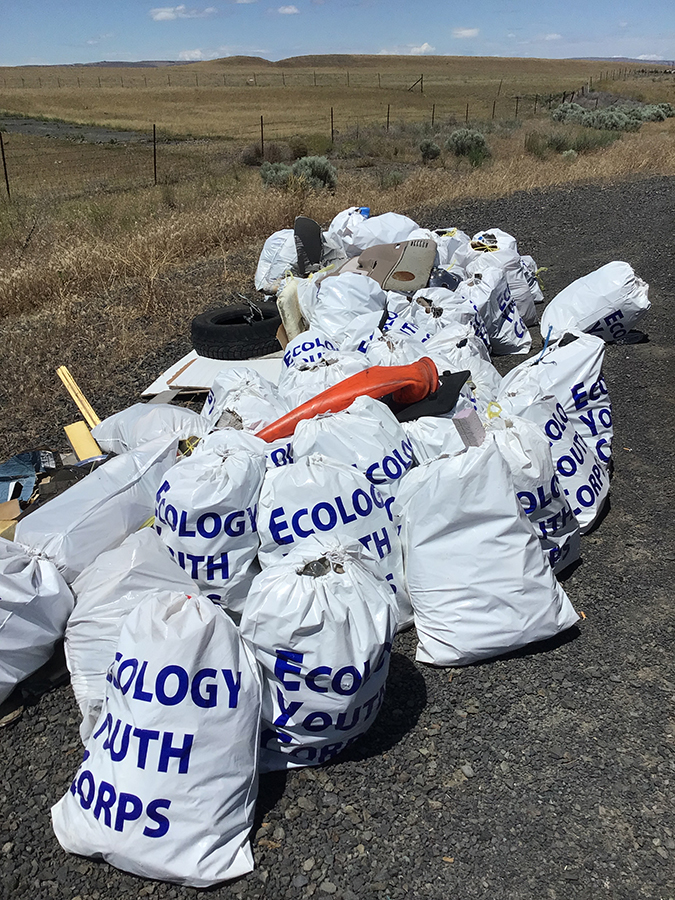
A typical litter cleanup job involves Ecology Youth Corps and adult crews bagging the litter and our crews collecting the bags and transporting them to landfills. In the first four months of 2023, crews have collected 1,648 tons (roughly 220,000 total bags) of trash. Our total for 2023 is only expected to increase as more litter pickup occurs across the state during warmer weather.

Department of Ecology Youth Corps collected a large amount of trash and other debris in eastern Washington this past summer and will be back
again this year across the state.

You may be wondering why the spike in litter totals this year? For the early part of the year there has been an increase in cleaning at encampments, including some of the work in Governor Inslee’s and the state Legislature’s Right of Way Safety Initiative to offer housing to the people living in state rights of way and close encampments. At times a site can’t be cleared because housing hasn’t been identified but our crews can still clean up the area and/or do regular trash collections to help keep trash from accumulating or spreading. While the amount litter collected near encampments is significant, it’s also important to note that historically it’s not the major type of trash we clear from roadways. Once crews are out in full force this spring and summer we expect to see significant increases in the overall litter totals we also report from other items such as leftover lunches to larger items like mattresses and desks (which pose safety hazards as well as adding to roadside litter). Essentially basic, every-day litter.

The spring and summer litter crews include the Ecology Youth Corps crews, who work in July and August and are paid roles. Ecology’s adult crews work from March to November and are paid roles as well. More information about Ecology’s work crews are available by clicking this link.

Along with Ecology, we contract with the Department of Corrections to hire inmates who choose to participate in the program to gain professional work experience, earn some money and give back to their communities while being supervised. Our contracts prohibit participants with serious offenses or security risks.

Here’s a look at the before and after of Department of Corrections work along I-5 near Tacoma.

Q: Most of the trash has to be from encampments near the highway, right?

A: In 2022, approximately 466 tons of trash was collected near encampments statewide. In 2021, that number was 166 tons – almost three times less. People living homeless on state rights of way is a far-reaching issue that can’t be resolved by a transportation agency alone. When addressing litter associated with an encampment, we remove the debris and hazardous waste after an encampment site has been vacated – and must rely heavily on other state agencies, non-profits, local jurisdictional and behavioral health partners before a site can be cleaned. (As mentioned above, we may also do regular trash collections at some sites waiting for housing to be identified). The outreach and planning work to connect people with social and medical services and other options is key to closing encampments long term versus just having people disperse to another outdoor location.

A look at litter under the SR 705 and I-5 interchange in Tacoma and after a contractor
cleaned the area in late January

As far as addressing encampments, our maintenance crews and contractors work to clean them and we also work with neighboring jurisdictions to coordinate large-scale cleanups like in Tacoma and Seattle. For January through April of 2023, our maintenance crews and contractors reported they’ve cleaned up a combined total of 1,453 tons of trash from encampments across the state. Some of our crews utilize contractors for encampment cleanups while other crews do the work themselves to reduce costs. To date, contractors have collected and disposed of 176 tons of our overall 1,453 tons from encampments.

Q: You’re not doing enough when it comes to litter. Can’t you just allocate more money to your maintenance budgets to focus on litter cleanup?

A: Along with the Department of Ecology, we spend a combined $12 million on litter cleanup annually. Even with such a large expenditure, the litter problem is constant and increasing at rates greater than our crews, volunteers and partners can reasonably collect. The main need is to prevent litter on our roadways and rights of way in the first place, which is why we have supported Ecology’s latest litter prevention campaign, Keep Washington Litter Free. This campaign includes messages on our highway reader boards, a robust social media campaign and seasonal litter emphasis patrols by the Washington State Patrol.

Highway signs show a variety of anti-litter messages throughout the year.

Highway maintenance work is prioritized and measured through a statewide accountability process based on funds allocated to us by the state Legislature and legal mandates we are obligated to meet for safety. In many cases we simply cannot defer critical maintenance work to focus only on litter – many of these other tasks are important for life/safety concerns. Roads must be cleared of ice and snow during the winter to keep people and goods moving. We also have thousands of miles of guardrail due for replacement and bridge decks that need repairs to extend their useful life. Our agency oversees approximately 18,700 lane miles, 3,300 state bridges and 120 miles of dedicated bike lanes across the state so there is a lot of work to do on a daily basis with limited funds.

Our roles in litter cleanup include:

  • Responding and removing any trash in active traffic or posing an immediate safety risk
  • Removing large items or debris (mattresses, couches) that potentially block traffic
  • Removing roadkill
  • Cleaning trash found near other roadside repair activities, as time allows
  • Collecting and disposing of all bags of litter collected from roadsides by Adopt-a-Highway volunteers, Ecology Youth Corps crews and Department of Corrections crews

We work hard to balance the needs of our aging transportation system while also addressing litter as time and resources allow.

Maintenance crews pick up trash bags and debris along westbound SR 8 near McCleary

Q: How did the COVID-19 pandemic affect litter pickup over the past few years?

A: Highway litter pickup was severely affected by the pandemic, including several litter cleanup programs put on hold due to safety and exposure concerns. That has led to an increase in highway litter. Due to COVID-19 safety restrictions, volunteer Adopt-a-Highway crews, the Department of Ecology Youth Corps and state and local departments of Corrections crews were not available for 2020 and parts of 2021 – meaning most of the “normal” highway litter cleanup did not take place or did so at reduced levels. Last year, due to the increase in trash after two years of a global pandemic, we increased our own litter duties statewide, while also focusing on graffiti removal, to help address the backlog.

Q: Why can’t you just fine people seen dumping furniture or trash bags along the highway?

A: The most important reason is we are not an enforcement agency and have no authority to issue citations. Enforcement on state highways is handled by the Washington State Patrol while local law enforcement handles other areas. Under state law, litter tickets and fines require the violation be witnessed by a sworn law officer. They cannot be issued based on reports given to or witnessed by our staff. Littering and illegal dumping are against the law in Washington. Fines range from $103 to $5,000. Many cities and counties have local ordinances that are stricter than the state law.

Q: There is a stretch of highway sponsored by a local business, and I don’t believe they are doing a good job at picking up the litter. How often do groups need to pick up trash to maintain good standing before possibly being removed?

A: There are two types of Adopt-a-Highway cleanup programs and they require a specific number of cleanings per year, rather than cleaning all litter as soon as it accumulates.

  • Adopted areas: These are areas adopted by volunteer groups, which could be a group of business employees, a family, a club, etc. The group receives an acknowledgement sign for their efforts. Groups must clean their sites a minimum of four times a year.

If an adopted location has not been picked for more than six months, local agency coordinators will contact the group leader and request they act with urgency. If a group is unresponsive or not compliant with their agreement, they are notified that their agreement will be canceled, their recognition sign removed and their section of road made available to another group for adoption. This rarely happens; however, we have had to make the decision to revoke an adoption. Some of our groups have been participating in the program for decades and take great pride in their work as valuable volunteers to Washington state.

  • Sponsored areas: For these sites a company partners with a state-approved contractor to clean a stretch of road – often areas where volunteers can’t operate due to safety concerns. The contract includes placing an acknowledgement sign recognizing the company’s efforts. The company’s name and logo – which must be reviewed by our agency -- also can only take up one-third of the entire sign. Federal law states the signs must be acknowledgements and not ads for the businesses – and they also cannot include details like addresses, phone numbers or hours of business.

Sponsorship contracts require six cleanings a year. If a sponsorship contract fails to meet their minimum cleaning requirements, the same follow up happens with the group as with adopted areas.

Adopt-a-Highway volunteers pick up litter along SR 99 in King County. We have
655 actively registered groups across the state

We need your help

Okay, we’ve answered some common questions we receive about litter but now have an ask of you – please help us keep Washington beautiful and litter free. We ask the public to:

  • Properly cover and tie down all loads, on all trips
  • Keep trash and debris securely gathered in vehicles until you reach home, so it doesn’t fall out or fly out of vehicles. The Department of Ecology provides free litter bags that are available for pick up at Fred Meyer locations throughout the year in Washington state.
  • Properly dispose of all trash; do not dump it at rest areas, parking lots or other land.
  • Share litter prevention messages with friends and family
  • If able, consider creating an Adopt-a-Highway group to join the valuable volunteers who help clear roadsides and other rights of way.