Thursday, December 28, 2023

Protecting US 2: Project reduces debris flow risk to highway near Bolt Creek Fire burn scar

By David Rasbach

The 2022 Bolt Creek Fire burned nearly 15,000 acres in the Mount Baker-Snoqualmie National Forest. We had to close US 2 east of Gold Bar several times because of the active fire and debris falling onto the highway. The fire also left a burn scar that will take several years to recover.

Even after the fire, there is still a chance that debris, such as rocks and mud, might flow down from the Bolt Creek Fire burn scar. But we have good news! We just finished a project that will make it less likely for debris flows to block travel along US 2/Stevens Pass Highway.

Burn scars and debris flows

Wildfires can change the landscape, turning dense trees and vegetation into large areas with ashes and dry soil, known as burn scars.

If it rains a lot or snow on the ground melts really fast, these burn scars can produce fast-moving landslides called debris flows. These can be dangerous and might harm people and property within their path.

After the Bolt Creek wildfire, our geotechs studied the area and found two areas near the burn scar, about four miles northwest of Skykomish, where there is a higher risk of debris flows that could affect US 2.

Protecting the road: culverts and berms

In one of these areas, there are two culverts under US 2 that might get clogged if debris flows down the stream.

If the culverts clog, water, rocks and even trees could spill across the highway, forcing us to close it to clean up and maybe fix the guardrails and pavement.

To reduce this risk, we built two debris fences – one 60 feet long and the other 110 feet long – above each culvert. These fences should help stop some of the debris that reaches the culverts if a debris flow happens.

A stream channel above US 2 about 4 miles northwest of Skykomish. The channel is filled with rocks, and vegetation grows nearby. A long compost sock sits near the channel to control erosion.
Debris fences were installed along the stream channels above two culverts under US 2 to help
reduce the chances a debris flow could clog the culvert.

concrete being poured into a square wooden frame in the ground. A circular rebar foundation is in the center of the square.
Crews pour a post foundation for a new debris fence along US 2.

A large, blue and yellow drill balanced on a hill side drills an anchor hole for a debris fence being installed along US 2 near Skykomish. A crew member sits above the drill.
Work crews drill holes where anchors for posts that will support a debris fence
along US 2 will be installed.

a worker stringing up a debris fence between two metal posts in the ground. Two circles are suspended on wires, and an orange plastic fence is in the background.
Crews begin hanging a new debris fence along US 2 near Skykomish.

Work crews placing a tan erosion blanket over the earth berm along US 2. A dump truck towing a trailer with construction equipment sits along the shoulder of the highway.
The project installed two debris fences above culverts that run under US 2.

A few hundred feet up the highway, our geotechs identified a second area where a debris flow could slide across US 2.

In this area, our experts thought it would be a good idea to build a 6-foot-tall wall, called a berm, made of natural materials. This berm will guide any potential debris flows away from US 2 to a lower natural “catch” area near the highway. The berm is 94 feet long and required nearly 300 tons of material to build.

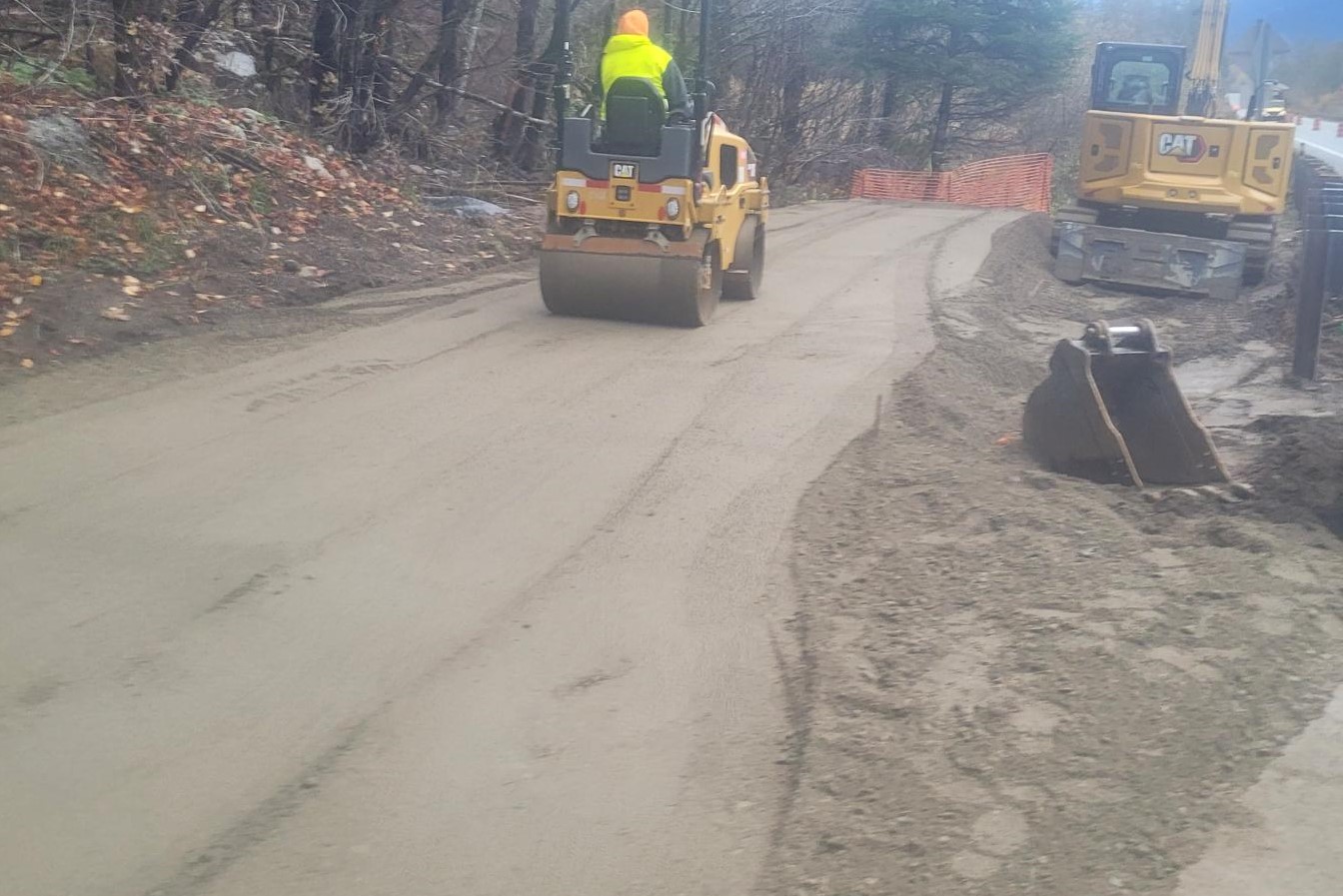
A worker on a roller compacting a pile of dirt along US 2 near Skykomish. An excavator sits along the berm next to the guardrail.
Crews began compacting soil that will make up an earth berm that will help protect US 2 from a
potential debris flow from the Bolt Creek Fire burn scar.

A berm made out of dirt along US 2 near Skykomish. An excavator is parked on the side of the road.
The completed earthen berm stands 6 feet tall and is 94 feet long. It will help protect US 2 in the event of a debris flow in the area, channeling the flow to a natural lower “catch” area.

Work crews placing a tan erosion blanket over the earth berm along US 2. A dump truck towing a trailer with construction equipment sits along the shoulder of the highway.
An erosion blanket is placed atop the new earthen berm. The berm will help direct a
potential debris flow in the area away from US 2.

The completed earthen berm with an erosion blanket over the top. An orange construction barrel sits on the shoulder of US 2 near the berm.
The completed earthen berm stands 6 feet tall and is 94 feet long. It will help protect US 2 in the event of a debris flow in the area, channeling the flow to a natural lower “catch” area.

Finishing up work

In order to get all of this work done, we had to make some changes to the traffic on US 2, but most of the work is done now. In spring 2024, we’ll add native plant seeds to help stabilize the area, but we won’t need any lane closures for that work.

Our maintenance crews will keep an eye on the highway along the burn scar, looking for downed trees and limbs, clearing ditches and culverts and looking for any early warning signs of a potential debris flow.

Hopefully, the berm and the fences are never tested by a debris flow, but Mother Nature is uncontrollable. What we can control is that we have taken the necessary steps to reduce the risk and keep US 2 open while the area recovers from the Bolt Creek Fire.

Monday, December 18, 2023

Answering your questions about toll rate changes for I-405 and SR 167

By Chris Foster

The Washington State Transportation Commission — which is responsible for setting toll rates — recently began work to assess and adjust toll rates for the Interstate 405 and State Route 167 express toll lanes. The Commission has released its toll rate proposal, which includes:

  • Increasing the minimum toll rate to $1
  • Increasing the maximum toll rate to $15
  • Extending evening tolling on I-405 by one hour, to 8 p.m.

The goal of the express toll lanes is to provide a reliable trip for transit, carpoolers and drivers who choose to pay a toll. To achieve this goal, the express toll lanes use dynamic pricing to set the toll rates.

When traffic volumes in the express toll lanes are low, the toll rate is low. As lane volumes increase, so does the toll rate which helps avoid overfilling the lanes to ensure a reliable trip for people choosing to use the lanes.

The Washington State Transportation Commission recently proposed
increasing toll rates on I-405 and SR 167.

The Commission has not adjusted toll rates for the SR 167 HOT lanes and the I-405 express toll lanes since the toll facilities opened in 2008 (SR 167) and 2015 (I-405). The decision to increase toll rates is never made lightly and is informed by careful analysis.

With that in mind, we want to provide a chance for you to share your thoughts on the proposed toll rate proposal.  You can get more information on the proposal, the process, the schedule and how to provide comments on the Commission’s website.  The Commission will hold its final hearing regarding the proposed changes at 9 a.m. on January 29. The hearing will be virtual and you can register to attend and comment on the Commission’s website.

We also know you probably have questions about the decision to adjust toll rates. We’ll answer some of the more common questions we receive and share the rationale behind why increasing the minimum and maximum toll rates is needed.

Why now?

With the new Renton to Bellevue express toll lanes scheduled to open in 2025, assessing the toll rates for the current facilities is necessary to ensure consistency for the future 50-mile corridor. However, a couple of different factors play into the updated timing for the rate adjustments currently being considered:

  • Per state law, the Commission is required to periodically review toll rates in relation to traffic performance of all lanes to determine if the toll rates are effectively maintaining travel time, speed and reliability. The Legislature included further direction regarding rate adjustments in the most recent transportation budget.
  • Population in the corridor has increased significantly since these facilities opened, and congestion has continued to worsen. As a result, the express toll lanes are unable to consistently meet their performance goals, and people paying to use the lanes are experiencing slower speeds.

One of the key metrics we use to measure express toll lane performance is how often traffic is traveling 45 mph or more during peak periods (5 to 9 a.m. and 3 to 7 p.m.). The graph below shows the percentage of time speeds reached or exceeded 45 mph during the past year.

Only the northbound I-405 peak period— which features more capacity with two express toll lanes between Bellevue and Bothell — is consistently meeting the 45 mph metric. The remaining three sections often reach the maximum rate due to high demand, at which point the ability to manage traffic and ensure a reliable trip is limited.

The Renton to Bellevue Widening and Express Toll Lanes project will add two new express toll lanes in each direction. Increasing the maximum rate will provide greater ability to manage traffic when many people are choosing to use the lanes, and help generate revenue for important corridor projects such as the I-405 Brickyard to SR 527 Improvement project and the SR 167 Toll Equipment Upgrade project.

Won’t this price out people who can’t afford to use the lanes for $15?

Most people won’t end up paying the maximum toll rate. In September 2023, the average daily toll paid by drivers with an active Good To Go! account and pass installed in their vehicle was $2.41 for the I-405 express toll lanes, and $3.36 for the SR 167 HOT lanes. During that same time, only 4 percent of trips reached the maximum rate in the I-405 express toll lanes, and 8 percent in the SR 167 HOT lanes.

If and when the toll rate reaches its maximum, that means many people are choosing to pay for a reliable trip, most likely due to heavy congestion in the general purpose lanes. We know some drivers will adjust their travel times, as the maximum toll rate is typically only reached during peak periods. Other drivers may adjust the way they commute (by joining a carpool or using public transportation).

How often will toll rates reach the new maximum?

We don’t know for sure how often the lanes will fill up and slow speeds down, causing the rates to increase. We do know that the current rates are reaching the maximum rate during peak periods more frequently, and when that happens, performance decreases as travel speeds in the lane slow down for everyone. In other words, people are paying for but not receiving the intended 45 mph or better speeds.

We looked at how often speeds were reaching 45 mph during peak periods in September 2023 from Tuesdays to Thursdays — which are generally the days we see the highest traffic volumes — and how often the toll rates were reaching their maximum during that same timeframe.

As you can see in the chart above, sections of the corridor that reach the maximum toll rate more frequently are meeting the 45 mph speed metric less often. In other words, once the toll rates reach their maximums, our ability to manage the lanes is limited and the result is slower speeds and a less reliable trip.

What is the timeline for these changes?

The Commission’s schedule for making changes to the toll rates is as follows:

  • January 17/18, 2024: The Commission will take public comment on the selected toll rate changes.
  • January 29, 2024:  The Commission will hold a final hearing to adopt toll rate changes, and public comment will be taken at the hearing.
  • March 1, 2024:  Toll rate adjustments take effect.

You can sign up to attend and provide comments at the two January Commission meetings on their website.

Tuesday, December 12, 2023

The nuts and bolts of keeping our equipment running

By Tina Werner

Winter weather has arrived in the Pacific Northwest and you’ve likely already seen images of our snow plows and other equipment out keeping roads clear and safe. But what you haven’t seen much of is the work of our maintenance mechanics, the MVPs behind the scenes tirelessly working to keep that equipment running. And especially this time of year, that is no easy task. With more than 500 snowplows and many other pieces of equipment, it’s a never-ending challenge to keep everything ready to go for winter.

Earlier this fall our Wenatchee maintenance shop was hard at work preparing snow blowers
and dump trucks for winter operations.

By the numbers

While our named tow plows – Plowie McPlow Plow, The Big Leplowski, Sir Plows-A-Lot and Betty Whiteout – get a lot of attention, they are just four of 565 snowplows/dump trucks we maintain statewide. We also have 36 motor graders and 29 snowblowers, and it’s a lot of work to make sure they run smoothly each year. In 2023 alone, we spent 846 hours of labor on our snowplows, which ran for 18,000 hours. Combined that is approximately 815,000 miles traveled to clear and treat roads of snow and ice across the state – and doesn’t count labor or miles traveled for our graders or blowers, which you can imagine is a lot.

In preparation for this winter, we purchased just about 1,000 new plow bits – disposable parts that ride on the ground, shave snow and ice from the road and need to be replaced to keep equipment operational – to the cost of $976,380. Plow bits can be replaced monthly if they’re used in moderate snow and as often as every week in heavy snow, while maintenance shops that see little snow may only have to replace them every year.

And you thought maintaining your vehicle was expensive!

Getting and keeping our vehicles ready for winter is no small task, and includes installing and
replacing plow bits (left) and putting tire chains on some pretty big tires.

Our plows cover more than 20,000 lane miles and travel at slower speeds to clear snow properly, right around 25 to 35 miles per hour. Our snow removal equipment needs constant maintenance, and sourcing to find the right part in the event it wears out or is damaged in a collision is vital. Occasionally, our mechanics are able to piece various parts together and create one-of-a-kind repairs because some of our trucks are so old they don’t make parts for them anymore.  

Switching to winter

There is a lot that goes into a well-oiled maintenance shop and we aren’t just talking greasy hands and classic rock music. Our mechanics service dozens of vehicles every week and during storms they work both day and night to turn equipment around as quickly and as safely as possible to get snowplows back on the roads.

“It takes on average up to six hours to transition our dump trucks to operable snowplows during the winter,” said Bryan Dean, one of our equipment technician supervisors.

One of our Wenatchee mechanics works under a dump truck to prepare it for winter. It takes on
average about six hours to switch a dump truck into a snowplow.

Our mechanics remove the dump body from the truck (which is used to haul dirt and other debris during the spring and summer) and add the salt body container to the back (which holds salt for treating the roads). Then we add the actual plow to the front of the dump truck and do a full commercial vehicle inspection before we give them the green light. Our mechanics are checking things like the brakes, windshield wipers, hydraulic hoses and air lines. Additional time may be needed if other repairs are discovered.

We recently honored one of our hard-working maintenance mechanics, Perry Chappelle, with our agency’s Fleet Administrator of Excellence Award in Leavenworth, where he works. Perry has transformed the Leavenworth parts room into a well-functioning program while creating a positive team environment for his other technicians servicing equipment. He has made the procurement of hard-to-source parts easier for his team, which in turn puts big trucks and plows back onto the road faster. Without folks like Perry sourcing equipment parts and making critical repairs to our plows, it would take longer to clear the roads and longer for drivers to get where they need to go. We’re so grateful to Perry and all our mechanics for their fantastic work.

Perry Chappelle (left) is presented with our Fleet Administrator of Excellence award for his service
keeping our equipment running by Fleet Administrator Ernie Sims

We wouldn’t be who we are without the dedication of our employees – and especially this time of year - our mechanics.

Join our team + we will train you to succeed!

We are always looking for great people to join our team and that includes mechanics. We also provide ongoing training to our current staff so they can learn the ins and outs of equipment sourcing, repairs and to maintain their commercial drivers license to operate a snowplow. If you are interested in working on some mighty machines where your work helps keep travelers all over the state safe, check out our employment page and search “equipment technician, mechanic or highway maintenance worker” in the field bar.

Wednesday, May 31, 2023

Changing the look of I-5 in downtown Seattle

Tony Black

Over a 48-hour period, the look of Interstate5 in downtown Seattle changed for the first time in almost 50 years.

A new flyover ramp, connecting State Route 520 directly to the I-5 express lanes, is taking shape. Crews set the foundation for that ramp – steel girders – over the May 19-21 weekend.

A before-and-after look at the steel girders placed over northbound I-5
and the express lanes in Seattle

The process itself is far from simple, and normally could take at least two full weekend closures of northbound I-5 to do. But with a busy construction season ahead, we wanted to minimize the disruption the best we could.

Together – the work and messaging – was a great example of teamwork between the public, our contractor Walsh and us. For that we thank you.

This wasn’t a “traditional” weekend closure as we worked with our contractor to stagger the closure times, leading to lots of questions. A Twitter thread
helped answer those questions.

What happened

Over the May 19-21 weekend, our contractor set and assembled 15 very large steel girders. The girders are 75-100 feet long, 5-feet-5 inches tall and weigh about 36,000 pounds.

They used two cranes to lift them and set them on the concrete piers and crossbeams you’ve seen sitting between northbound I-5 and the express lanes for a few months now.

The steel girders arrived by truckload in the days leading up to and during the closure.

This was no easy task, and at one point a lightning storm stopped all work. Crews needed to not only set the girders but bolt them down so we could safely reopen the lanes below for traffic.

In all, it involved two crews of 25 construction workers from Walsh, working alongside our inspectors and traffic operations over four shifts to pull this off. The result was a new bridge in one weekend, and northbound I-5 was closed for only 15 hours late Friday night into Saturday afternoon.

As the cranes position the girders, crews prepared to tighten them into the concrete piers.

Why steel?

We used steel girders because it would enhance the support of the type of traffic that will use this ramp, primarily transit and HOV carpools. The combination of curve of the road and length of the spans also made using steel the best option.

Two cranes lifted the pre-assembled steel girders into position.

What’s next?

Setting the girders is a significant milestone for our project and we are now entering what I call the “sweet spot” of this project.

In addition to building the new flyover ramp this year:

The westbound SR 520 off-ramp to East Roanoke Street is fully closed until 9 p.m. on June 17. This is so we can finish building a new retaining wall and then ultimately shift the Roanoke and northbound I-5 ramps to the north.

We have some more work to do on Mercer Street too and you can expect some lane and possible weekend closures there as well.

This project is still on track for a spring 2024 completion.

The final girders were set late Sunday night as crews finished the work in just 48 hours.

A final thank you

Just once more I want to thank everyone – you, the public, our contractor Walsh, and their partners for making this happen.

Spring/summer is always a busy time of year for construction, and we really need everyone’s help to keep things smooth and moving.

Friday, May 12, 2023

WWI items found in records audit

By WSDOT Staff

Our Records and Information Management (RIM) team didn’t expect much excitement as they worked on auditing our holdings at the State Records Center. A somewhat arduous project, it involves poring over hundreds of records, items and artifacts from the agency collected between 1950 and 1990. So when agency records personnel came across what looked like a box of precious personal items, it caused them to pause.

The artifacts included a wallet, bank books, and sentimental keepsakes from service in World War I – all of which belonged to a man named Fred Gloor. With the help of a little internet sleuthing, Records & Information Services Administrator Shannon Gill found out Fred was a World War I veteran, and a Department of Highways civil engineer who worked in the Vancouver area during the 1950s.

Fred Gloor, a World War I veteran who worked as a civil engineer with the Department of Highways
in the Vancouver area in the 1950s

With curiosity peaked, Shannon reached out to her uncle, a genealogy buff. Through Ancestry.com, they were able to connect with Fred’s great nephew, Steve. Steve and his wife Brenda were thrilled to hear about the discovery of the records, and recently made a visit to our Olympia headquarters to meet with the RIM team to take home their great uncle’s personal items.

Though Steve knew of his great uncle, he did not have any personal memories as Fred passed away at least 15 years before Steve was born.  Shannon and her Records & Information Management staff shared the story of the records discovery, and how they believe the items ended up with us.

Fred Gloor’s great nephew Steve and his wife Brenda posing with some of Fred’s artifacts we discovered during a recent audit

The Records & Information Management team thinks Fred did not retire in a traditional sense. In the 1940s, Shannon said it was common to store personal items at your workplace, as many people did not have a home office. If Fred’s career with the agency had a sudden end, it would make sense that such precious items were left behind. Shannon noted that this was before the agency maintained emergency contacts for employees, so they may have not been able to contact his family members to return the items.

Shannon believes the items were left in a desk drawer in our Vancouver-area office from 1950 to 1990, when it was transferred to the Records & Information Management Office. Unsure what to do but recognizing they were probably important to someone, someone likely boxed the items and put them in storage in the State Records Center in the early 1990s.

A couple of pictures of Fred Gloor, a civil engineer with the Department of Highways and WWI veteran. Our Records and Information Management team recently found some of Fred’s keepsakes during an audit.

Steve and Brenda were in awe of how many items were returned to them, as well as the pristine condition they were in. They also liked discovering their relative’s connection to our agency.

The discovery of the records was not only special for Fred’s family members. It was also a treat for the Records & Information Management team to discover and investigate artifacts that they wouldn’t normally find.

“This has been a very bright spot for our team during a large and often boring project,” Shannon said.

Thursday, May 11, 2023

Answering your top questions about litter cleanup ahead of a busy summer construction season

By Tina Werner

We can all agree that trash is unsightly and diminishes the natural beauty of our Evergreen State. Yet every day, anything from thousands of pieces of debris to mattresses or desks fly out of vehicles and end up along our highways. According to 2021 research commissioned by the Washington State Department of Ecology, 26% of litterers say they would be motivated to stop if “a friend, family member, or passenger asked me to refrain.” Who knew it was so easy?

So. …while we may not be your friend or family member, maybe you can pretend just this once: Please, please, please stop littering. Seriously. It’s illegal, it’s selfish and it’s gross.

We get asked about litter frequently – especially at this time of year. So we wanted to answer some of your most burning litter questions and share what you can do to help us in our efforts. (Hint: it involves not littering).

Maintenance workers clean up litter along an eastbound I-90 ramp near Easton in late April

But before we get to the questions, a quick look at where we’re at.

In 2022 our maintenance workers, crews from the Department of Ecology and the Department of Corrections and volunteers in the Adopt-a-Highway program collected more than 1,400 tons of trash – roughly the weight of six blue whales. We’ll keep working at it, but ultimately our workers can’t be everywhere picking up after people 24/7. We need the public’s help preventing litter from reaching the roads in the first place.

OK, on to the questions:

Q: I drive I-5 through (insert your city) five days a week and don’t see anything happening. Why are you never out there?

A: The most active litter cleanup work typically happens between March and November as cold, wet weather and less visibility makes it more unsafe in the winter. Once November hits our crews usually switch to winter-related maintenance work but now that spring is back, litter cleanup will become more active.

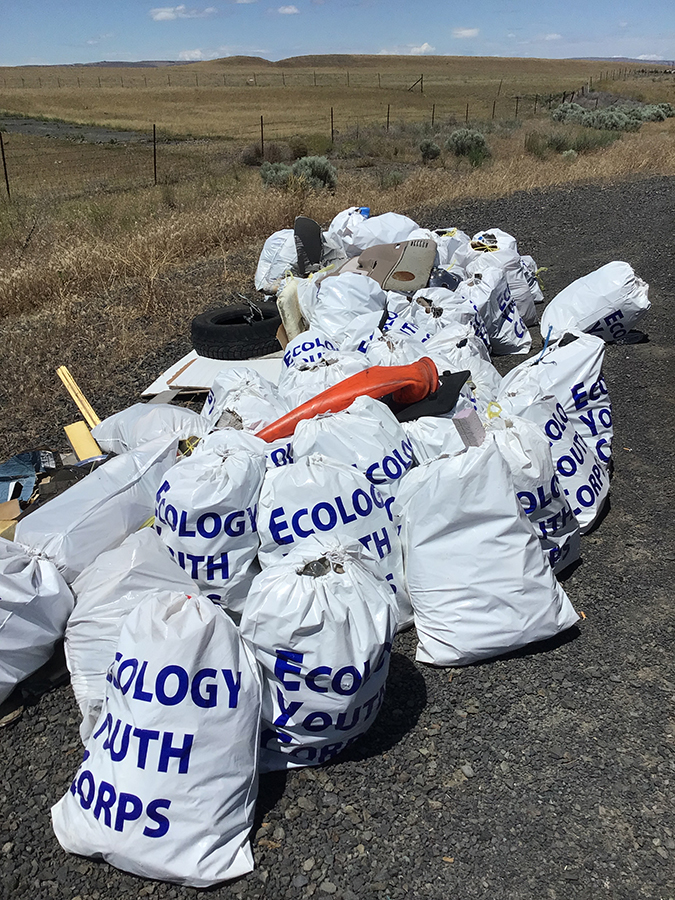
A typical litter cleanup job involves Ecology Youth Corps and adult crews bagging the litter and our crews collecting the bags and transporting them to landfills. In the first four months of 2023, crews have collected 1,648 tons (roughly 220,000 total bags) of trash. Our total for 2023 is only expected to increase as more litter pickup occurs across the state during warmer weather.

Department of Ecology Youth Corps collected a large amount of trash and other debris in eastern Washington this past summer and will be back
again this year across the state.

You may be wondering why the spike in litter totals this year? For the early part of the year there has been an increase in cleaning at encampments, including some of the work in Governor Inslee’s and the state Legislature’s Right of Way Safety Initiative to offer housing to the people living in state rights of way and close encampments. At times a site can’t be cleared because housing hasn’t been identified but our crews can still clean up the area and/or do regular trash collections to help keep trash from accumulating or spreading. While the amount litter collected near encampments is significant, it’s also important to note that historically it’s not the major type of trash we clear from roadways. Once crews are out in full force this spring and summer we expect to see significant increases in the overall litter totals we also report from other items such as leftover lunches to larger items like mattresses and desks (which pose safety hazards as well as adding to roadside litter). Essentially basic, every-day litter.

The spring and summer litter crews include the Ecology Youth Corps crews, who work in July and August and are paid roles. Ecology’s adult crews work from March to November and are paid roles as well. More information about Ecology’s work crews are available by clicking this link.

Along with Ecology, we contract with the Department of Corrections to hire inmates who choose to participate in the program to gain professional work experience, earn some money and give back to their communities while being supervised. Our contracts prohibit participants with serious offenses or security risks.

Here’s a look at the before and after of Department of Corrections work along I-5 near Tacoma.

Q: Most of the trash has to be from encampments near the highway, right?

A: In 2022, approximately 466 tons of trash was collected near encampments statewide. In 2021, that number was 166 tons – almost three times less. People living homeless on state rights of way is a far-reaching issue that can’t be resolved by a transportation agency alone. When addressing litter associated with an encampment, we remove the debris and hazardous waste after an encampment site has been vacated – and must rely heavily on other state agencies, non-profits, local jurisdictional and behavioral health partners before a site can be cleaned. (As mentioned above, we may also do regular trash collections at some sites waiting for housing to be identified). The outreach and planning work to connect people with social and medical services and other options is key to closing encampments long term versus just having people disperse to another outdoor location.

A look at litter under the SR 705 and I-5 interchange in Tacoma and after a contractor
cleaned the area in late January

As far as addressing encampments, our maintenance crews and contractors work to clean them and we also work with neighboring jurisdictions to coordinate large-scale cleanups like in Tacoma and Seattle. For January through April of 2023, our maintenance crews and contractors reported they’ve cleaned up a combined total of 1,453 tons of trash from encampments across the state. Some of our crews utilize contractors for encampment cleanups while other crews do the work themselves to reduce costs. To date, contractors have collected and disposed of 176 tons of our overall 1,453 tons from encampments.

Q: You’re not doing enough when it comes to litter. Can’t you just allocate more money to your maintenance budgets to focus on litter cleanup?

A: Along with the Department of Ecology, we spend a combined $12 million on litter cleanup annually. Even with such a large expenditure, the litter problem is constant and increasing at rates greater than our crews, volunteers and partners can reasonably collect. The main need is to prevent litter on our roadways and rights of way in the first place, which is why we have supported Ecology’s latest litter prevention campaign, Keep Washington Litter Free. This campaign includes messages on our highway reader boards, a robust social media campaign and seasonal litter emphasis patrols by the Washington State Patrol.

Highway signs show a variety of anti-litter messages throughout the year.

Highway maintenance work is prioritized and measured through a statewide accountability process based on funds allocated to us by the state Legislature and legal mandates we are obligated to meet for safety. In many cases we simply cannot defer critical maintenance work to focus only on litter – many of these other tasks are important for life/safety concerns. Roads must be cleared of ice and snow during the winter to keep people and goods moving. We also have thousands of miles of guardrail due for replacement and bridge decks that need repairs to extend their useful life. Our agency oversees approximately 18,700 lane miles, 3,300 state bridges and 120 miles of dedicated bike lanes across the state so there is a lot of work to do on a daily basis with limited funds.

Our roles in litter cleanup include:

  • Responding and removing any trash in active traffic or posing an immediate safety risk
  • Removing large items or debris (mattresses, couches) that potentially block traffic
  • Removing roadkill
  • Cleaning trash found near other roadside repair activities, as time allows
  • Collecting and disposing of all bags of litter collected from roadsides by Adopt-a-Highway volunteers, Ecology Youth Corps crews and Department of Corrections crews

We work hard to balance the needs of our aging transportation system while also addressing litter as time and resources allow.

Maintenance crews pick up trash bags and debris along westbound SR 8 near McCleary

Q: How did the COVID-19 pandemic affect litter pickup over the past few years?

A: Highway litter pickup was severely affected by the pandemic, including several litter cleanup programs put on hold due to safety and exposure concerns. That has led to an increase in highway litter. Due to COVID-19 safety restrictions, volunteer Adopt-a-Highway crews, the Department of Ecology Youth Corps and state and local departments of Corrections crews were not available for 2020 and parts of 2021 – meaning most of the “normal” highway litter cleanup did not take place or did so at reduced levels. Last year, due to the increase in trash after two years of a global pandemic, we increased our own litter duties statewide, while also focusing on graffiti removal, to help address the backlog.

Q: Why can’t you just fine people seen dumping furniture or trash bags along the highway?

A: The most important reason is we are not an enforcement agency and have no authority to issue citations. Enforcement on state highways is handled by the Washington State Patrol while local law enforcement handles other areas. Under state law, litter tickets and fines require the violation be witnessed by a sworn law officer. They cannot be issued based on reports given to or witnessed by our staff. Littering and illegal dumping are against the law in Washington. Fines range from $103 to $5,000. Many cities and counties have local ordinances that are stricter than the state law.

Q: There is a stretch of highway sponsored by a local business, and I don’t believe they are doing a good job at picking up the litter. How often do groups need to pick up trash to maintain good standing before possibly being removed?

A: There are two types of Adopt-a-Highway cleanup programs and they require a specific number of cleanings per year, rather than cleaning all litter as soon as it accumulates.

  • Adopted areas: These are areas adopted by volunteer groups, which could be a group of business employees, a family, a club, etc. The group receives an acknowledgement sign for their efforts. Groups must clean their sites a minimum of four times a year.

If an adopted location has not been picked for more than six months, local agency coordinators will contact the group leader and request they act with urgency. If a group is unresponsive or not compliant with their agreement, they are notified that their agreement will be canceled, their recognition sign removed and their section of road made available to another group for adoption. This rarely happens; however, we have had to make the decision to revoke an adoption. Some of our groups have been participating in the program for decades and take great pride in their work as valuable volunteers to Washington state.

  • Sponsored areas: For these sites a company partners with a state-approved contractor to clean a stretch of road – often areas where volunteers can’t operate due to safety concerns. The contract includes placing an acknowledgement sign recognizing the company’s efforts. The company’s name and logo – which must be reviewed by our agency -- also can only take up one-third of the entire sign. Federal law states the signs must be acknowledgements and not ads for the businesses – and they also cannot include details like addresses, phone numbers or hours of business.

Sponsorship contracts require six cleanings a year. If a sponsorship contract fails to meet their minimum cleaning requirements, the same follow up happens with the group as with adopted areas.

Adopt-a-Highway volunteers pick up litter along SR 99 in King County. We have
655 actively registered groups across the state

We need your help

Okay, we’ve answered some common questions we receive about litter but now have an ask of you – please help us keep Washington beautiful and litter free. We ask the public to:

  • Properly cover and tie down all loads, on all trips
  • Keep trash and debris securely gathered in vehicles until you reach home, so it doesn’t fall out or fly out of vehicles. The Department of Ecology provides free litter bags that are available for pick up at Fred Meyer locations throughout the year in Washington state.
  • Properly dispose of all trash; do not dump it at rest areas, parking lots or other land.
  • Share litter prevention messages with friends and family
  • If able, consider creating an Adopt-a-Highway group to join the valuable volunteers who help clear roadsides and other rights of way.

Monday, April 24, 2023

Deactivating the 511 Phone Number – and tools to use instead to stay informed

By Lisa Walzl

Starting Friday, May 19, Washington state travelers will no longer be able to access automated statewide travel information by calling 511.

For the past 20 years, the 511 phone number has provided a way to receive traffic impacts, crash alerts, current and future weather forecasts, mountain pass conditions and ferry information (schedules, fares and wait times) as well as reversible-express lane status.

So, why is 511 going away? Simply put, new technology has led to a dramatic decrease in the number of people using the service.

Despite high call volumes in the early years of the program, during the past decade, the number has received a steady decrease in usage every year. In 2009 511 had more than 2.2 million calls but in 2022 that number fell to less than 302,000 calls – that’s an 86 percent decrease.

There are a number of likely reasons for the decline in calls – most of them due to new technology. As most of us know, smart phones, the internet and social media have changed our daily life and routines. We think tools like our app and travel map, social media platforms, third-party mapping services and GPS systems integrated into vehicles all have made travelers less likely to call 511. That means it’s not the valuable tool it once was for many travelers.

The 511 phone system is also expensive to operate, costing more than $150,000 a year in hard costs and requiring many staff hours to continually update travel information in the increasingly antiquated technology and to maintain signs about the program.

The steady decrease in use, antiquated technology and cost were the deciding factors in the decision to deactivate the 511 phone number. Once discontinued, these resources will be reallocated to more efficient and emerging information technologies to better serve Washington travelers.

Alternatives to the 511 automated information

While 511 is being discontinued, there still are many ways travelers in Washington can receive timely and accurate travel information, including our app, our website with real-time travel maps, social media accounts, electronic highway variable message signs and highway radio stations – as well as several private mapping apps for smartphones and integrated GPS systems in vehicles.

Travel tools include:

Travelers who do not have access to the internet/smart phone apps

While 511 is going away, there still are ways to get your travel information by landline phone. If you don’t have internet or smart phone access, you can contact us at the numbers below (you may also want to program some of these numbers into your phone or otherwise save them for easy reference):

  • Washington State Ferries’ information phone number 888-808-7977
  • Tolling information (Good To Go!) 866-936-8246
  • Amtrak Cascades 800-872-7245
  • Neighboring states 511 information
    Oregon 503-588-2941
    Idaho 888-432-7623
  • Local weather
    Seattle 206-526-6087
    Spokane 509-244-5992
  • Our Offices

Tuesday, March 21, 2023

Graffiti: A tale of two signs

By April Leigh and Tina Werner

Opinions about graffiti vary almost as much as the expression itself. It’s an art form to some and a nuisance for others. In the context of tagging along highways and bridges, graffiti poses many concerns for us.

Graffiti is illegal under Washington state law. It puts people in danger (those doing the tagging along a busy highway and our crews involved in the removal) and costs taxpayers thousands of dollars annually. It also takes away from other work we do to keep our transportation system in good working order like repairing potholes and guardrails.

We do our best to keep up with requests to remove graffiti, especially on directional signs and in areas that cause distractions for drivers. Unfortunately, our crews often report that a location is tagged again within days or even hours of graffiti removal.

Crews removing graffiti in the pedestrian/bicycle path above the Mount Baker tunnel in Seattle.

In February, graffiti was sprayed across two overhead directional signs on the off-ramp from southbound Interstate 5 to State Route 512 in Tacoma. The defaced signs posed a significant distraction for drivers and covered directions for traffic, so they had to be removed immediately.

These overhead signs on the southbound I-5 exit to SR 512 and South Tacoma Way had to be removed and replaced after they were tagged with graffiti.

These overhead signs are located along a very busy stretch of I-5 and have been repeatedly targeted. A temporary directional sign was moved to the roadside while maintenance crews started work on a fix. When all was said and done, both overhead signs had to be replaced and a catwalk removed from the sign structure to prevent future tagging.

Whoever vandalized the signs had to crawl across that catwalk to do it – endangering their life and the lives of everyone who passed underneath them.

Replacing signs – particularly overhead ones – is a timely and expensive task. In this case, the graffiti defaced the entirety of the directional signs, and they were not able to be salvaged.

How much does something like this cost? Our team is still calculating the final bill, but replacing both signs is estimated to be between $40,000 and $50,000. That includes labor, equipment and materials.


Crews use large trucks equipped with hydraulic arms and buckets to replace the overhead sign on the ramp from southbound I-5 to SR 512 and South Tacoma Way.

The cost of graffiti

Graffiti removal projects like this are paid out of our maintenance and operations budget. Our crews prioritize critical maintenance activities (PDF 187KB) like catch basin cleaning, snow and ice removal, mowing for sightlines and other work. The more resources we spend on graffiti removal, the less we have for this other work.

In the past two years, our maintenance teams have spent $1.4 million on graffiti removal. In the next biennium, we expect to spend even more to address the growing issue.

Graffiti vandalism on the rise

We’ve seen an increase in graffiti vandalism along our state roads over the past few years. Newly completed bridges, overpasses, walls, and other structures are often hot spots for these crimes as they offer a fresh blank canvass for taggers. Active construction projects with new or closed sections of roads also attract activity because there is no traffic there at night.


A section of a new wall along SR 16 in Tacoma before and after graffiti removal.

Crews often have to use special equipment to access the vandalized areas – like trucks with lifts to reach high places that would otherwise be used to maintain, inspect or clean state bridges. Using equipment like this also requires traffic control or a lane closure during daylight hours. This is a huge challenge when we’re also trying to keep traffic moving.

What about designed safe-graffiti spaces?

Some people have shared that they’d like us to allow for portions of our highways and other facilities to be safe-expression spaces for graffiti artists. Safety plays a big role in this effort along with consistent monitoring of the spaces for vulgar or offensive language.

We are aware and have been evaluating the innovative artist in residence program and how it could help address safe-graffiti spaces. However, we are currently in the middle of legislative session where bills have been introduced on this topic and we are awaiting hearing what the results are.

How graffiti removal is prioritized

While graffiti is a crime and a law enforcement issue, the cleanup is our responsibility and we do so as often as we can. We prioritize removing graffiti with vulgar or obscene phrases. As we are not a law enforcement agency and don’t have enforcement authority, we partner with law enforcement, but they must catch someone in the act of tagging to be cited for vandalism. Given that much of the tagging happens at night, this is a huge challenge.

We aren’t funded to have or hire specific-graffiti removal teams. It takes time and planning to coordinate a cleanup site. We try to roll this work into other projects occurring in the same area to minimize disruptions to drivers, and work with neighboring cities and counties on prioritizing large sections that draw noticeable concern. You can report highway graffiti online too – and we share that directly with our crews to address as time and resources allow.

We’re often asked why we don’t use our traffic cameras to help law enforcement capture taggers in the act. Our traffic cameras only provide the most current snapshot image. We don’t record footage from them as that would require a significant investment to support storing video from more than 600 cameras statewide. Law enforcement must catch someone in the act of vandalism to potentially arrest a person on state property.


Crews removed graffiti from this I-5 sign near Marysville at 88th St NE.

Bottom line: There’s always been, and likely always will be graffiti. Along with law enforcement, we will do the best we can within our resources to try to keep up, but ultimately it’s up to those committing the crimes to stop putting themselves and others at risk.

Wednesday, February 15, 2023

Looking at alternatives for I-5 through the Nisqually River Delta

By Mark Krulish

It’s the traditional home of the Nisqually Indian Tribe. Visitors to the ecologically diverse Billy Frank Jr. National Wildlife Refuge know the area is home to bald eagles, waterfowl and a pit stop for migrating birds. The river at this location divides Thurston and Pierce counties. Within this setting sits Interstate 5 – the main mover of people and goods along the west coast, from Mexico to Canada.

How will this I-5 corridor look and feel in the future? That’s what we are studying right now. …and we need your input.

We are tasked with making the best decisions for the future of this critical connection. Every step of the way, we need you to help us make those decisions.

Now through March 1, we have several design options that we want your feedback on.

Studying the alternatives

Lately we have been busy looking at different alternatives to improve this roadway. As part of this process, we have been collaborating with local governments, local tribes, transit agencies, JBLM and the Federal Highway Administration.

A look at one of the design options for the Nisqually Valley project, including a new elevated I-5 interchange

In our February round of advisory meetings, we will look at these design options to get feedback from these representatives.

But we also need input from the public. This is where we need your help.

Submit your feedback

Through the end of February, our engage web page will host a few different design options under consideration.

A look at another design option for the Nisqually Valley project

We have simple improvements to reduce demand for single-occupancy vehicles. This would rely on coordination with local governments and entities to work in tandem with us to implement their own strategies for things such as express bus service and providing support for alternative travel modes – such as walking and biking. This option could also include environmental improvements for the Nisqually River channel by replacing the existing bridges with new structures.

We also have designs to widen I-5 in the area by adding general purpose or HOV lanes, converting general purpose lanes to HOV, or building a long, elevated bridge up over the Nisqually River Delta area.

Take a look at the designs on our engage web page. Once you have reviewed them, there will be a place to leave your feedback. This is the best way to ensure your comments are incorporated into final report.

Keep up with the latest news on our project page, where we post materials and videos of our meetings with local agencies. You can also sign up for email updates here. Simply click on the link and enter your email address.

Tuesday, January 17, 2023

Public input needed for PEL study that shapes the future of I-5 over the Nisqually River Delta

By Mark Krulish

Interstate 5 and the Nisqually River Delta are both important for multiple reasons. I-5 is the main mover of people and goods along the west coast, from Mexico to Canada. The Nisqually River is the traditional home to the Nisqually Indian Tribe, the local fish species and ecosystems that support it.

This month, we are meeting with advisory groups to begin identifying elements of a project that looks at improvements to I-5 across the delta. The first step is reviewing what is known as a Purpose & Need statement, and we need you to weigh in on this.

What is a Purpose and Need statement

Quite simply, a Purpose & Need statement lays out why a project is necessary. It is the foundation of any environmental review process. We will use it to look at different design alternatives for the I-5 corridor from Marvin Road to Mounts Road.

We may choose to adopt this Purpose and Need statement. Our goal is to not have to revisit the Purpose and Need during the National Environmental Policy Act (NEPA) review process. This is why we need your input now. This work will hopefully cut down on the amount of work needed as we eventually move into a NEPA review this summer.

Your comments will be incorporated into this process and will help shape our final outcome and, ultimately, what will be built.

A look at the Nisqually study area

How to participate

You can find the Purpose and Need statement several different ways. Our link on our Engage page has the statement and an easy way to leave feedback through our form. You can also find a link to the document on our project website. The contact tab on our project page has a phone number and email address at which you can also leave comments.

If you’re interested in staying in touch with us and hearing about the latest information on the project, we have a newly created email list specifically for this project. You can subscribe here. Click on the link and enter your email address.

Don’t miss your chance to let us know what your need is on I-5 in this area. Please note that we will respond to comments through our incorporation of feedback into the draft PEL Report rather than responding to individuals. The report will be available for comment early this summer.